

Table of Contents:
- What Is LifeTrend? Brand Background and Product Lineup
- LifeTrend Cold Plunge Specs: Alta, Solitude, and Sierra Compared
- Is LifeTrend Worth It for Commercial Use? The Honest Assessment
- LifeTrend Warranty, Return Policy, and Purchase Channel Risk
- LifeTrend vs. Commercial-Grade Cold Plunge Alternatives: What to Consider
- LifeTrend Cold Plunge Reviews: What Real Users and Independent Reviewers Say
- Frequently Asked Questions
- The Bottom Line: Who Should Buy LifeTrend — and Who Shouldn't
Cold therapy has moved past trend status. Wellness centers featuring cold therapy now report 25% higher customer retention compared to those without it, recovery suites in high-end gyms have grown 15% year-on-year globally, and the commercial segment is forecast to represent 79% of total cold plunge tub market share in 2025, according to Persistence Market Research. For facility managers, a cold plunge decision isn't an amenity upgrade — it's an ROI decision with retention, revenue, and member experience implications attached to it.
LifeTrend keeps surfacing in that conversation. You'll find it in Costco carts, fitness retailer catalogs, and no shortage of Reddit threads. But dig into the YouTube reviews and independent write-ups, and a different picture starts to emerge — one that doesn't show up in the product listing photos.
Here's the thing: LifeTrend is not a scam. It's also not a commercial-grade cold plunge unit. It occupies a specific, narrow lane that works for some buyers and genuinely fails others. This post will tell you exactly which side of that line your facility falls on.
At Blue Sky Fitness Supply, we evaluate cold plunge equipment the way commercial facility managers need to: against daily throughput demands, warranty structure, installation requirements, and total cost of ownership — not backyard hobbyist standards. We'll cover the three main LifeTrend models (Alta, Solitude, and Sierra), dig into the spec transparency gaps that matter for procurement decisions, address the warranty and purchase channel risks that aren't obvious from product listings, and give you a straight answer on whether LifeTrend is worth it for cold plunge commercial use — or whether you should be looking elsewhere.
What Is LifeTrend? Brand Background and Product Lineup
LifeTrend is a brand name, not a standalone company. It belongs to Lifesmart Products, whose parent store Make Life Easy (makelifeeasy.com) also operates the LifeSmart, EZLIFE, and WalkingPad brands, according to Cold Plunge Daddy's review. That distinction matters more than it might seem.
When you purchase a LifeTrend cold plunge, your warranty and service relationship is with Lifesmart Products and makelifeeasy.com — not a dedicated cold plunge manufacturer with specialized support infrastructure. There's no LifeTrend-specific commercial account team, no dedicated service network, and no published multi-unit pricing program. For a boutique buyer purchasing a single unit, that may be acceptable. For a facility manager speccing out a recovery suite or evaluating multiple units, the organizational reality of who you're actually dealing with should factor into that decision.
The brand's three flagship products each occupy a distinct position in the market:
- The LifeTrend Alta is the most accessible entry point — a single-person, 61-gallon, 110V plug-and-play unit positioned for buyers who need low installation friction and don't have 220V infrastructure.
- The LifeTrend Solitude is a Costco-exclusive model, budget-positioned at approximately $2,999, targeting value-conscious buyers through a channel with strong buyer protections.
- The LifeTrend Sierra is the brand's largest unit — a 3-to-4-person hot tub and cold plunge combination measuring 91" × 85", requiring 220V and a certified electrician for installation.
LifeTrend products reach buyers through makelifeeasy.com, Costco, Home Depot, Wayfair, and independent fitness retailers. That channel diversity is worth paying attention to, because the purchase channel affects your return options and buyer protections more than it typically does with other equipment brands — a point covered in detail in the warranty section below.
One genuine positive worth acknowledging: LifeTrend uses Balboa chillers and Gecko circulation pumps across its lineup. These are established, name-brand components with known performance specs and a real aftermarket parts ecosystem — unlike the no-name OEM hardware that populates most sub-$4,000 cold plunge units. That said, good components don't compensate for a weak warranty structure or a parent company with no dedicated commercial support infrastructure. It's a meaningful positive signal, but it's not the whole picture for a commercial operator evaluating a 5-year equipment relationship.
For facility managers building the business case for cold plunge investment, understanding what cold plunge recovery can deliver for members is a foundational step before evaluating which unit to buy — the clinical and performance evidence is substantial and worth reviewing before you start comparing models. Blue Sky's LifeTrend collection includes the models discussed in this post alongside supporting recovery equipment, so you can compare specs and pricing in one place as you work through this evaluation.
LifeTrend Cold Plunge Specs: Alta, Solitude, and Sierra Compared
Commercial buyers need numbers. Here are the specs for each model, along with the gaps that matter for procurement decisions.
LifeTrend Alta
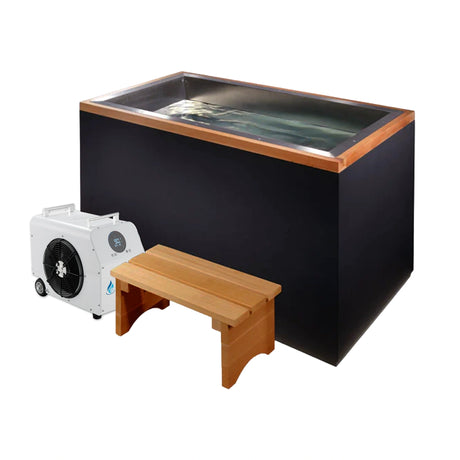
The Alta measures 77" L × 31.5" W × 30" H and weighs 293 lbs dry. It holds 61 gallons, runs on a standard 110V/60Hz outlet (no electrician required), and uses a Balboa chiller capable of cooling water to 37°F and heating to 102°F. The Alta includes a Gecko Circulation Pump, a built-in UV Ozonator, a 50 sq ft filtration system, full polyfoam shell insulation, and a 2.4" high-insulation cover. Bluetooth speakers and underwater mood lighting are also included — features that add member experience value but are secondary to performance specs for commercial operators, according to the Dick's Sporting Goods product listing.
The 110V design is the Alta's most defining characteristic for commercial use. Plug-and-play installation is genuinely convenient for facilities without 220V infrastructure. But 110V units generally cool more slowly and struggle to maintain target temperatures when ambient room temperature climbs above 75°F. For a climate-controlled indoor recovery suite, that may be manageable. For any environment where ambient temperature varies, it's a real throughput constraint.
LifeTrend Solitude
The Solitude is Costco-exclusive and carries an approximate retail price of $2,999, down from an original $3,999. Published specs are thin. Costco lists it as "outdoor use only," and warranty details are not displayed on Costco's product page, according to In House Wellness's review. For commercial buyers, the limited published specifications are a concern — it's difficult to make a defensible procurement decision without dimensional data, electrical requirements, and filtration specs on the record.
LifeTrend Sierra
The Sierra is the brand's most capable unit on paper. It measures 91" L × 85" W × 31" H, weighs 960 lbs dry, holds 288 gallons, and requires a 220V/60Hz circuit and a certified electrician for installation. The cold section uses a Balboa 1100W chiller with a 0.75HP circulation pump. The hot section offers 21 jets and accommodates 3–4 users. A 1-year limited warranty comes standard, with optional 2- and 3-year extended plans available, per The Fitness Outlet's listing.
Before any Sierra installation, a structural floor load calculation is non-negotiable. At 288 gallons of water (approximately 2,400 lbs) plus a 960-lb dry unit, total loaded weight approaches 3,360 lbs. The Sierra's 91" × 85" footprint covers roughly 53.6 square feet. A standard commercial floor rated at 150 lbs/sq ft can theoretically support that — but "theoretically" is not an engineering sign-off. Facility managers planning heavy equipment placement like this should consult a structural engineer and review our commercial flooring guide for load-bearing and surface considerations before installation, not after.
The Spec Transparency Problem
The missing spec data for LifeTrend's single-person models — no published cooling rate, chiller wattage, or heater wattage — is not a minor omission for commercial buyers. When specifying equipment for a recovery suite or athletic training room, operators need to know how fast a unit will chill from ambient to target temperature, and how it performs when ambient room temperature is 75°F or higher. Without published numbers, you can't benchmark, and you can't make a defensible procurement decision.
An independent reviewer at Cold Plunge Daddy also found that published water capacities across LifeTrend's acrylic cold plunge range contradict each other on the brand's own store and cannot both be correct given the published shell sizes. For a brand asking commercial operators to trust its equipment specs for recovery programming decisions, that's a credibility gap worth noting.
LifeTrend Model Comparison Table
| Feature | LifeTrend Alta | LifeTrend Solitude | LifeTrend Sierra |
|---|---|---|---|
| Capacity (gallons) | 61 | Not published | 288 |
| Dimensions (L × W × H) | 77" × 31.5" × 30" | Not published | 91" × 85" × 31" |
| Dry Weight | 293 lbs | Not published | 960 lbs |
| Electrical Requirement | 110V/60Hz (plug-and-play) | Not published | 220V/60Hz (electrician required) |
| Chiller | Balboa (wattage not published) | Not published | Balboa 1100W |
| Temperature Range | 37°F – 102°F | Not published | Not published per vessel |
| Users | 1 | 1 | 3–4 |
| Key Features | Gecko pump, UV Ozonator, 50 sq ft filtration, polyfoam insulation, Bluetooth speakers, mood lighting | Limited published data | 21 jets, hot/cold combo, 0.75HP circulation pump |
| Warranty | 1 year limited | Not shown on Costco listing | 1 year limited (2- and 3-year extended plans available) |
| Retail Price (approx.) | ~$3,500–$4,500 | ~$2,999 (Costco) | ~$6,000–$8,000+ |
| Primary Purchase Channel | makelifeeasy.com, Dick's Sporting Goods, Wayfair | Costco | The Fitness Outlet, independent retailers |
| Commercial Viability (Blue Sky Assessment) | Limited — suitable only for low-traffic boutique settings with realistic expectations | Very limited — opaque specs, outdoor-only warranty, better for personal use | Moderate — multi-user throughput helps, but requires engineering review and 220V; warranty still consumer-grade |

Is LifeTrend Worth It for Commercial Use? The Honest Assessment
The core tension here is straightforward. LifeTrend is consumer-to-prosumer positioned hardware being evaluated against commercial-grade standards. That gap — between what the product was designed for and what commercial operators need from it — is where most buyer regret comes from.
The gym and wellness center cold plunge sub-segment was valued at USD 108.6 million in 2025 and is projected to reach USD 204.4 million by 2033, growing at a compound annual growth rate of 8.3%, according to Grand View Research. Over 70% of professional sports teams in North America have already adopted cold-water immersion as part of official recovery protocols, per Brass Monkey's research. Cold plunge recovery is not a niche offering anymore — it's becoming a baseline member expectation in premium fitness and wellness facilities. The question isn't whether to invest in cold plunge. It's whether LifeTrend is the right vehicle for that investment.
Where LifeTrend Has Real Strengths
The Balboa and Gecko component sourcing is a genuine differentiator at this price point. These are serviceable parts with documented specs and real availability through HVAC and pool supply channels. If something fails, a technician can diagnose and source parts — that's not guaranteed with the no-name OEM hardware populating most budget cold plunge competitors.
The Alta's plug-and-play 110V design lowers installation friction for facilities without existing 220V infrastructure. Costco's pricing on the Solitude is genuinely competitive for a chiller-equipped unit. The Sierra's 3-to-4-person capacity addresses throughput in a way the single-person units cannot.
Where LifeTrend Falls Short for Commercial Operators
Four specific limitations matter most:
- The single-vessel design of the Alta and Solitude makes them fundamentally incompatible with contrast therapy protocols. Alternating hot and cold immersion — the protocol driving adoption in elite athletic and premium wellness contexts — requires two separate vessels or near-instant temperature switchover. Neither unit can deliver that.
- A 1-year warranty on a refrigerated appliance with pumps, electrical systems, and plumbing is below the commercial-grade industry norm. Chiller service typically becomes likely in years 2–3 of daily commercial use. Factor extended warranty cost into total cost of ownership before comparing sticker prices to alternatives.
- The missing cooling rate, wattage, and performance data for the single-person models prevents meaningful benchmarking. Commercial procurement decisions require published specs — not because buyers are being difficult, but because facility managers are accountable to ownership and members for the performance claims they make.
- The Alta's 110V limitation becomes a real operational problem in warm ambient environments. A recovery room that runs 72–78°F ambient can stretch a 110V chiller's ability to maintain 37–45°F target temps under continuous use.
From a commercial facility standpoint, the distinction between a plug-and-play residential unit and commercial-grade recovery equipment isn't just about specs — it's about total cost of ownership over a 5-year horizon. Factor in: extended warranty cost, likely chiller service at year 2–3, downtime impact on member experience, and the freight costs embedded in LifeTrend's warranty claim process. A unit that looks $1,500 cheaper at point of purchase may not be cheaper over its operational life.
LifeTrend does not publish commercial volume pricing or multi-unit support programs. Facilities planning more than one unit should factor the absence of commercial account infrastructure into their decision — because once you're managing two or three units with different warranty timelines and no dedicated support channel, the operational burden adds up.
Honest Verdict by Use Case
Boutique studio or small facility, low daily throughput, tight budget, purchasing through Costco: the LifeTrend Alta or Solitude may be viable — with realistic expectations about cooling performance, warranty limitations, and the absence of contrast therapy capability.
Mid-to-large gym, recovery suite, high daily traffic, or contrast therapy programming: LifeTrend falls short. Commercial-grade alternatives with 2–3 year warranties, published cooling specs, and multi-user throughput are the right category for that use case. The cold plunge recovery investment is worth making — just with equipment that can actually hold up under commercial demand.

LifeTrend Warranty, Return Policy, and Purchase Channel Risk
This is the section most product listings won't tell you about. For commercial buyers, warranty structure and purchase channel risk carry more weight with LifeTrend than they do with most other equipment categories.
LifeTrend's standard warranty runs one year. Claims require the buyer to prepay return freight in both directions, according to Cold Plunge Daddy's independent review. On a 293-lb Alta, prepaid freight in both directions is not a footnote — it's a material cost. On a 960-lb Sierra, that cost becomes genuinely prohibitive. Calculate it into your total cost of ownership before you close the purchase.
The outdoor/indoor warranty ambiguity is a commercial liability risk, not just an inconvenience. LifeTrend's warranty excludes outdoor use — on units that are marketed and photographed outdoors, and in the Solitude's case, listed at Costco explicitly as "outdoor use only." A facility that installs a unit marketed for outdoor use but warranted only for outdoor use, and then places it indoors, may have a $3,000–$8,000 asset sitting outside warranty coverage from day one. For commercial operators, that's not an acceptable risk. Document everything in writing before closing the purchase — get clarity on whether your intended installation environment (indoor vs. outdoor) is covered under the specific model you're buying, not just the brand's general marketing language.
Direct returns from makelifeeasy.com carry a 30% restocking fee plus two-way shipping. On a $3,000–$5,000 unit, that's potentially $900–$1,500 in sunk costs to return equipment that doesn't perform as expected. That math makes the purchase decision consequential in a way that most equipment buys aren't.
Costco changes that calculus meaningfully. Costco's return policy is substantially more buyer-protective than makelifeeasy.com's direct terms. For any buyer who has already decided on LifeTrend and is specifically interested in the Solitude, purchasing through Costco when the unit is in stock is the lower-risk channel — full stop. The trade-off is limited spec transparency on the Costco listing itself, which means doing your research before the purchase rather than relying on the channel to surface it for you.
When Blue Sky evaluates cold plunge equipment for commercial accounts, warranty structure is a first-pass filter. A 1-year warranty with prepaid freight requirements and ambiguous outdoor/indoor coverage is not a warranty designed around commercial operator confidence. It's a consumer warranty that commercial buyers can use — but they should do so with eyes open, not with the assumption that it functions the same way a 2- or 3-year commercial warranty does.
Practical guidance: before completing any LifeTrend purchase, document your intended installation location, intended commercial use, and the seller's warranty coverage confirmation in writing. If a warranty claim arises later, you want that paper trail. If the seller can't or won't confirm coverage for your specific installation scenario, that's information you need before purchase — not after.

LifeTrend vs. Commercial-Grade Cold Plunge Alternatives: What to Consider
If you've evaluated LifeTrend and found it doesn't fully fit your facility's requirements, the next question is what criteria should actually drive your search. The global cold plunge tub market was valued at USD 337.7 million in 2024 and is projected to reach USD 482.8 million by 2033, growing at a compound annual growth rate of 3.73%, according to IMARC Group. North America holds approximately 39% of that global market, per Persistence Market Research. There's no shortage of options — which makes having a clear evaluation framework more important than ever.
The Seven Criteria That Matter for Commercial Operators
- Warranty length and freight terms — 2–3 years with manufacturer-covered freight is the commercial-grade benchmark
- Published cooling specs — British Thermal Unit rating, cooling rate from ambient to target temp, and chiller wattage must be available for defensible procurement
- 220V vs. 110V infrastructure — 220V units cool faster, maintain target temps more reliably under load, and handle warm ambient environments better
- Single-user vs. multi-user throughput — calculate daily member demand and match unit capacity accordingly
- Contrast therapy capability — facilities offering hot/cold alternation protocols need separate vessels or dual-temp systems designed for that use case
- Volume and commercial pricing programs — multi-unit facilities need a vendor with commercial account infrastructure, not consumer retail terms
- Serviceability and parts availability — Balboa and Gecko components score well here; units with proprietary or unspecified components score poorly
Where LifeTrend is genuinely competitive: for a small-footprint, single-user, plug-and-play unit under $4,000, the Alta's 110V format is rare at this price point. If your facility has no 220V available, a tight budget, and low daily throughput, the alternatives at comparable price are limited. Acknowledge that honestly.
Where facilities should expect to pay more for the right tool: operators running 8 or more users per day, offering contrast therapy, or positioning cold plunge as a premium revenue tier are in a different product category entirely. Commercial-grade chillers, 220V infrastructure, 2–3 year warranties, and published performance specs are non-negotiable at that scale. That's not a LifeTrend conversation — and saying so is more useful than forcing the comparison.
When we work with commercial accounts evaluating cold plunge, the first questions we ask aren't about price — they're about daily throughput (how many members per day?), installation environment (indoor or outdoor, ambient temperature), contrast therapy intent (hot-cold alternation?), and electrical infrastructure (is 220V available?). Those four answers immediately narrow the field to the right equipment category. LifeTrend makes the shortlist for some of those scenarios. For others, it doesn't belong on the list at all.
Blue Sky carries the LifeTrend 4D Heated Massage Chair for facilities building out recovery suites — that product genuinely fits commercial use and rounds out a recovery offering with massage therapy alongside cold plunge. The point isn't to dismiss LifeTrend wholesale. It's to use the right tool for the right job. Above-ground cold plunge tubs like the Alta are forecast to hold 60% of the total market in 2025 due to affordability — the format is clearly viable. The question is always fit for purpose at the scale you're operating.
For operators building the business case for cold plunge investment internally, the clinical and performance evidence base is deep — the "Cold Plunge Benefits for Athletic Recovery: What 55+ Studies Actually Reveal" resource covers that ground in detail and is worth reviewing before you finalize your equipment specification.
Blue Sky's cold plunge and recovery equipment collection includes commercial-grade options built for daily operator use — units with published performance specs, commercial warranty terms, and multi-user throughput designed for the demand profiles real facilities run. Comparing options side by side with those criteria in front of you will make the right call more obvious than any single review can.

LifeTrend Cold Plunge Reviews: What Real Users and Independent Reviewers Say
Independent reviews of LifeTrend paint a consistent picture: solid value at the price point for personal or light-use applications, with meaningful limitations that surface quickly in commercial or high-throughput environments.
Cold Plunge Daddy's hands-on review notes that the Balboa and Gecko components genuinely perform as expected — the hardware inside the units is not the problem. What reviewers consistently flag is the warranty friction (prepaid freight both ways), the spec transparency gaps, and the cooling performance ceiling in warm environments. Multiple Reddit threads from gym owners echo the same pattern: the Alta works fine as a single-unit addition to a boutique studio with low daily demand; it struggles as a revenue-tier recovery amenity under real daily throughput.
The Costco Solitude generates the most favorable user sentiment, primarily because Costco's return policy backstops the purchase risk that makelifeeasy.com's direct terms create. Users who bought through Costco report a more confident ownership experience — not because the unit itself is different, but because the buyer protection is categorically better.
The Sierra has fewer independent reviews in circulation, which itself reflects its market position: it's purchased by a smaller pool of buyers willing to commit to 220V installation and the higher price tier. The reviews that exist acknowledge its multi-person capacity as a genuine commercial advantage, while flagging the 1-year warranty as under-matched to the investment level and the absence of published per-vessel performance specs as a gap for operators trying to build formal recovery programming around it.
The through-line across all independent LifeTrend reviews: the brand delivers on what it promises for its intended use case. The disconnect arises when commercial buyers apply consumer-product expectations to a commercial operating environment — or when product listings obscure the limitations that matter most for high-demand use.
Frequently Asked Questions
1. Is LifeTrend a legitimate brand for commercial cold plunge use?
LifeTrend is a legitimate brand, but it is not designed or supported as a commercial-grade cold plunge manufacturer. It belongs to Lifesmart Products (parent store: makelifeeasy.com), which also operates LifeSmart, EZLIFE, and WalkingPad brands. Products are sold through established retailers including Costco, Home Depot, and Wayfair, and the units use reputable Balboa and Gecko components. However, LifeTrend has no dedicated commercial account team, no multi-unit pricing program, and no specialized service network — limitations that matter significantly for facilities managing daily member throughput and multi-year equipment relationships.
2. What does the LifeTrend warranty actually cover, and what are the risks?
The standard LifeTrend warranty is 1 year and requires the buyer to prepay return freight in both directions for any warranty claim. On the Alta (293 lbs) and especially the Sierra (960 lbs), that prepaid freight is a significant cost, not a minor inconvenience. The warranty also excludes outdoor use — on units that are marketed and photographed outdoors — creating a coverage ambiguity that commercial operators must resolve in writing before purchase. The Sierra offers optional 2- and 3-year extended plans, which should be factored into total cost of ownership calculations from day one.
3. Which LifeTrend model is best suited for a commercial facility?
The LifeTrend Sierra is the most commercially viable model, as its 3-to-4-person capacity and 220V chiller offer meaningfully better throughput than the single-person Alta or Solitude. For boutique studios with low daily demand and no 220V infrastructure, the Alta's plug-and-play design makes it the most accessible option. The Solitude is not recommended for commercial procurement due to severely limited published specs and an outdoor-only listing. No LifeTrend model is recommended for high-traffic recovery suites, contrast therapy programming, or facilities needing commercial warranty terms.
4. Can LifeTrend cold plunges support contrast therapy protocols?
The Alta and Solitude cannot support contrast therapy — both are single-vessel units incapable of delivering the alternating hot and cold immersion required by contrast therapy protocols. The Sierra is a hot/cold combination unit and is structurally compatible with contrast therapy sequencing, as it includes separate hot and cold sections. However, the Sierra's temperature switching speed and performance specs per vessel are not published, and facilities planning formal contrast therapy programming should request those specifics from the retailer before committing to the purchase.
5. What are the installation requirements for the LifeTrend Sierra?
The Sierra requires a 220V/60Hz dedicated circuit and must be installed by a certified electrician. Its total loaded weight — 960 lbs dry plus approximately 2,400 lbs of water — approaches 3,360 lbs across a 91" × 85" footprint. A structural floor load assessment by a licensed engineer is strongly recommended before installation. Standard commercial floors rated at 150 lbs per square foot may require reinforcement or cannot safely support the Sierra without engineering review and, in some cases, structural modifications.
6. Why are LifeTrend's published specs incomplete for commercial buyers?
LifeTrend does not publish cooling rate, chiller wattage, or heater wattage for its single-person models (Alta and Solitude). This omission prevents commercial buyers from benchmarking performance, calculating throughput under real operating conditions, or making defensible procurement decisions based on documented specifications. An independent reviewer also identified contradictory water capacity figures across LifeTrend's product listings on the brand's own store. Facilities that need published performance data for procurement approval should treat this gap as a significant limitation rather than a minor inconvenience.
7. Where is the safest place to buy a LifeTrend cold plunge?
Costco is the lowest-risk purchase channel for the LifeTrend Solitude specifically, due to Costco's materially more buyer-protective return policy compared to buying direct from makelifeeasy.com. Direct purchases from makelifeeasy.com carry a 30% restocking fee plus two-way shipping on returns — a potential $900 to $1,500 in sunk costs on a $3,000 to $5,000 unit. The trade-off with Costco is limited spec transparency on the product listing, so all research should be completed before purchase rather than relying on the channel listing to surface critical specs.
8. How does LifeTrend compare to commercial-grade cold plunge alternatives?
Commercial-grade cold plunge units differ from LifeTrend primarily in four areas: warranty length (2 to 3 years with manufacturer-covered freight vs. LifeTrend's 1-year consumer warranty), published performance specifications (British Thermal Unit ratings, cooling rates, and chiller wattage), commercial account and multi-unit support infrastructure, and electrical capacity (220V as standard rather than 110V on entry models). For facilities running 8 or more users per day, offering contrast therapy, or positioning cold plunge as a premium membership tier, commercial-grade alternatives are the appropriate product category regardless of LifeTrend's lower entry price point.

The Bottom Line: Who Should Buy LifeTrend — and Who Shouldn't
LifeTrend occupies a specific, narrow lane. Budget-accessible cold plunge with reputable internal components — Balboa chillers, Gecko pumps — but consumer-grade warranty terms and no dedicated commercial support infrastructure. That description is not a criticism. It's a product category reality that determines who this brand serves well.
Two clear buckets:
Small or boutique facility, low daily member demand, tight capital budget, buying through Costco: the Alta or Solitude can work — with eyes open about warranty limitations, cooling throughput in warm environments, and the absence of contrast therapy capability. Wellness centers featuring cold therapy report 25% higher member retention, per Brass Monkey's research, even with entry-level equipment. Getting a unit in place matters.
Mid-to-large gym, recovery suite with real throughput, contrast therapy programming, or a cold plunge recovery tier priced as a premium membership feature: LifeTrend is not the right tool. The gym and wellness center cold plunge segment is growing at 8.3% compound annual growth rate, according to Grand View Research — this market is moving fast, and the facilities that win in it are the ones that spec equipment to match actual operational demands. A 1-year warranty and missing performance specs are not foundations for a high-traffic recovery suite.
If you're evaluating cold plunge for a commercial facility and LifeTrend doesn't fully fit your spec requirements, Blue Sky Fitness Supply carries commercial-grade cold plunge and recovery equipment built for daily operator use — with published performance specs, commercial warranty terms, and multi-user throughput designed for real facility demand. Browse our cold plunge and recovery collection to compare options side by side.
Blue Sky also carries the LifeTrend 4D Heated Massage Chair for facilities looking to build out a complete recovery suite with massage therapy alongside cold plunge — keeping LifeTrend in the picture where it actually makes sense for your operation.
Cold therapy is graduating from differentiator to baseline amenity in premium fitness facilities. The right equipment decision now is an investment in member retention and premium tier revenue — not just a line item on a capital budget.