Rubber Pavers for Horse Barns: Ultimate Safety & Installation Guide
Learn how rubber pavers for horse barns provide superior safety, slip resistance, and shock absorption compared to dangerous concrete flooring solutions.
ECORE Basic Fit Rubber Roll - 6mm Flooring
6mm Thin-Profile Roll for Light-Duty Fitness Areas
ECORE Basic Fit Rubber Roll - 8mm Flooring
8mm Entry-Level Roll for Cardio & Machine Areas
ECORE Basic Fit Rubber Roll - 9mm Flooring
9mm General-Purpose Roll for Commercial Gyms
ECORE Performance Motivate Rubber Roll - 7.5mm Flooring
7.5mm Dual-Layer Roll for Functional Training
ECORE Performance Motivate Plus Rubber Roll - 10.5mm Flooring
10.5mm Dual-VCR Roll for Strength Training
ECORE Performance Beast Rubber Roll - 10.5mm Flooring
10.5mm itsTRU Tech Roll for Shock Absorption
ECORE Performance Rally Rubber Roll - 14.5mm Flooring
14.5mm Best Seller All-Purpose Rubber Roll Made in the USA
ECORE Performance Beast Plus Rubber Roll - 14.5mm Flooring
14.5mm Heavy-Duty Roll for Olympic Lifting Zones
ECORE Performance Monster Rubber Roll - 22.5mm Flooring
22.5mm Triple-Durometer Roll for Extreme Lifting
ECORE Blade Rubber Roll - 9mm Flooring
9mm Skate & Cleat-Resistant Roll for Athletic Spaces
ECORE Rubber Floor Tiles - 8mm Interlocking
8mm Interlocking Tiles, 24 Colors, DIY Install
ECORE Performance UltraTile - 1" Rubber Tile
1" High-Density Best Selling Rubber Tile for Free Weight Areas
ECORE PlayGuard Rubber Tile - 2.5" Playground Flooring
2.5" Rubber Safety Tile for Playgrounds
ECORE Performance dBTile Rubber Tile - 2.5" Acoustic Flooring
2.5" Acoustic Rubber Tile for Sound & Shock Control
ECORE Bounce 2 Motivate Laminate Roll - 7mm Class 1 Flooring
7mm Athletic Laminate for Multipurpose Training
ECORE Baller Motivate Laminate Roll - 7mm Class 1 Flooring
7mm Court-Style Laminate for Athletic Spaces
It depends on the activity, but thicker isn't always better. For areas with machines or lighter weights, 8mm or under is typically fine. For areas with free weights and heavier lifts, 10mm+ is optimal
Choosing the right thickness comes down to what's happening on the floor. Lighter-use spaces like cardio zones, stretching areas, and selectorized machine rooms do well with ECORE's Basic Fit rolls in 6mm or 8mm — they provide solid shock absorption and noise reduction without overbuilding the floor.
General-purpose weight rooms with a mix of machines and moderate free weight use typically land in the 8-9mm range.
For spaces that see heavy deadlifts, Olympic lifts, or frequent weight drops, ECORE's Performance collection in 10.5mm or the Rally line at 14.5mm gives you the impact absorption and subfloor protection those activities demand.
When in doubt, go thicker — the cost per square foot difference is small compared to the protection and longevity you gain.
Not sure what thickness fits your space? Call us or request a free sample to feel the difference.
The big differences are aesthetics, installation cost, and portability.
When considering rubber tiles vs rubber rolls in your gym or fitness space, you should consider the following factors:
Appearance: Rubber rolls are often referred to as a seamless product. They get installed tight against each other, leaving no visible seams between them to provide a clean, seamless look. Tiles on the other hand will usually show some kind of seam between them. Some people love this look, and some people hate it — it all comes down to personal preference.
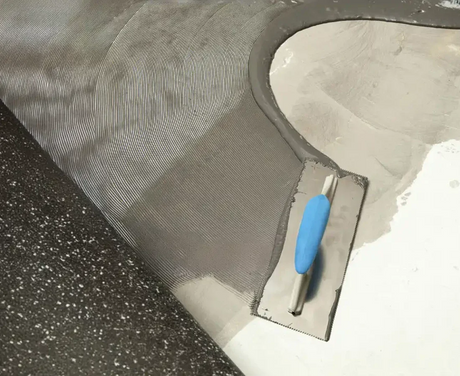
Installation: Rubber rolls are quite technical to install — especially if you've never done it before. We recommend professional installation which we provide as a part of our turnkey solution to outfitting a space. Tiles on the other hand, although still technical, can be performed as a DIY product for those who are handy and don't mind a weekend project. This difference can save a lot of money for those who opt to go the tile route.
Portability: When installed, in most cases, rubber rolls must be permanently adhered to your facilities subfloor, making it a permanent fixture within your facility. Once installed, rolls can never be removed without damaging the material making it unusable anywhere else. Tiles on the other hand are what's known as a 'floating system', meaning they can be installed, and then removed and reinstalled in another location later. This is a great solution for renters, or facilities where you expect a potential future renovation.
Yes — ECORE offers custom inlaid logos and platforms that are cut directly into the rubber flooring for a permanent, flush finish.
ECORE's ability to customize your floor with colors, logos, and designs lets you embed your school crest, team logo, facility name, or brand mark directly into rolled rubber flooring.
Unlike painted or printed logos that wear off over time, inlaid logos are precision-cut from colored rubber and fused into the floor so they sit perfectly flush with the surrounding surface.
This means they hold up to heavy foot traffic, equipment, and cleaning without fading or peeling. Custom inlaid platforms can also be embedded in your floor to provide clear visual cues to athletes where to stand and where to lift.
Customizations to your floor will add to the lead time on top of standard production, so it's best to plan early. Contact our team for a custom quote and artwork renderings.
Most ECORE rolls and tiles are made to order with a 4-week production lead time, plus about 1 week for transit — so plan for 5-6 weeks total. Custom logos and platforms will add additional lead time.
Because ECORE manufactures flooring to order at their facility in Lancaster, Pennsylvania, most products require approximately 4 weeks for production before they ship. Transit time to your location is typically an additional week, putting total delivery at 5-6 weeks from the date your order is placed. Orders consisting of custom logos and lifting platforms can require additional production time on top of the standard 4-weeks — reach out early if customization is part of your plan.
Orders under 100 lbs ship in standard cardboard packaging, while heavier orders are palletized and delivered via truck with a lift gate. If you're working on a tight timeline, give us a call — ECORE occasionally stocks certain colors and products that can ship sooner. We can often work something out when you're in a bind.
Sweep or vacuum daily and damp mop with ECORE's E-Cleaner diluted in water — no harsh chemicals needed.
ECORE rubber flooring is low-maintenance by design. For daily upkeep, remove loose dirt and debris with a broom, dust mop, or vacuum. For routine wet cleaning, dilute ECORE E-Cleaner in water and damp mop or run an auto-scrubber across the surface. E-Cleaner is pH-neutral, non-toxic, and biodegradable — it lifts dirt without leaving residue or damaging the rubber.
For a deeper refresh, ECORE's E-Strip removes built-up soil and old finish, and E-Finish applies a protective coating that resists scuffing and black marks.
One gallon of E-Cleaner covers roughly 2,000 sq ft for deep cleans and up to 6,000 sq ft for routine mopping, so a single jug goes a long way. Avoid bleach, ammonia, and solvent-based cleaners — they can break down rubber over time.
ECORE flooring ranges from roughly $3.5–$15+ per square foot depending on the product, thickness, and quantity. Rolls tend to be more affordable per square foot than tiles, and larger orders qualify for bulk project pricing.
Pricing varies based on the product line, thickness, and how much you're ordering. ECORE's Basic Fit rolls in 6mm start on the lower end, while thicker performance products and heavy duty tiles come in higher. Turf products have their own pricing tier as well.
The best way to get an accurate number is to request a quote — we provide bulk project pricing that factors in your square footage, product selection, freight, and installation if required.
Freight and installation are big variables with rubber flooring since it's heavy and no two facilities are the same, so we always quote that separately to make sure there are no surprises. You're also welcome to browse our product pages where we list pricing per square foot on every product.
Yes — we offer free samples on most ECORE products so you can see and feel the material before committing to a full order.
We know it's hard to commit to flooring based on photos alone, especially when you're outfitting an entire facility. That's why we offer free samples on most ECORE rubber flooring products.
Samples let you evaluate the thickness, texture, color, and density in person before placing a full order. Just contact our team and let us know which products you're considering and we'll get them shipped out. Samples ship via FedEx and typically arrive within a week.
Note that we'll call you prior to shipping out any samples to confirm your shipping address and project details.
Minimum order quantities vary by product. You can check the MOQ on any product page — the quantity selector will show the minimum and won't let you go below it. If you're unsure, reach out and we'll let you know.
Some ECORE products have minimum order quantities depending on how they're manufactured and shipped. The easiest way to check is on the product page itself — the quantity selector shows the minimum right in the field, and it won't let you select below it.
If you're working on a smaller project and aren't sure which products fit your budget and quantity needs, reach out to our team. We can help you find the right product for your space and square footage. For larger commercial projects, we offer project bulk pricing that brings the per-square-foot cost down significantly — just request a quote with your room dimensions or floor plan and we'll put together a full proposal.
Yes — ECORE rubber flooring can be installed over concrete, plywood, and most existing hard surfaces as long as the subfloor is clean, dry, and level.
ECORE products are designed to go over most common subfloor types. Concrete is the most common and works great with both rolls and tiles. Plywood works well too, as long as it's structurally sound and level. In some cases, you can install over existing hard flooring like VCT or vinyl — just make sure it's clean and firmly adhered to the subfloor underneath. The key requirement across all surfaces is that the subfloor needs to be clean, dry, flat, and free of debris.
For rolled rubber, the subfloor also needs to be smooth enough for the adhesive to bond properly, but not too smooth that the adhesive has nothing to grab onto.
Tiles are more forgiving since they float on top without adhesive in most cases.
If you're unsure whether your subfloor is ready, send us a photo and we'll let you know.