4.9 Star Rating · Read the reviews

For future promo info, sign up to our newsletter

Price match guarantee on ALL products!

Commercial Vinyl Plank Flooring

Why Standard LVT Underperforms ECORE's Rubber Performance Vinyl Tile (PVT) on 7 Dimensions

5.0 (10 ECORE reviews)

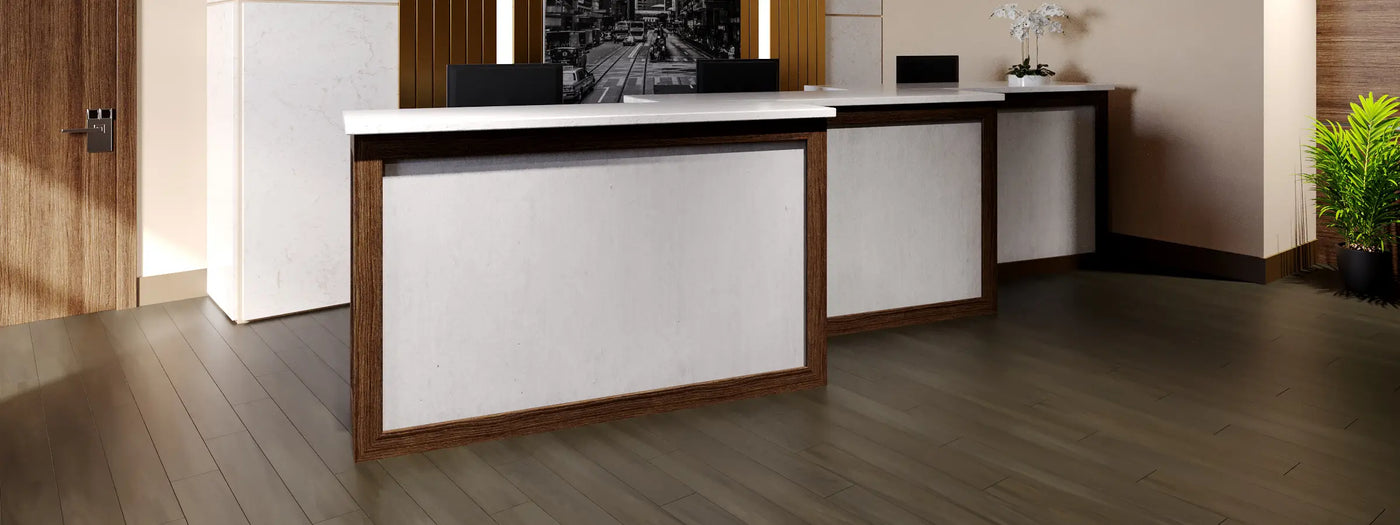
Made-in-USA commercial vinyl plank flooring spec'd for hotels, multifamily, senior living, corporate wellness, PT & rehab, premium home gyms, yoga & pilates studios, and multi-purpose rooms. ECORE's Heritage Motivate is built on Performance Vinyl Tile (PVT) construction — a 2mm vinyl wear surface fusion-bonded to a 5mm vulcanized composition rubber base. Same wood-look aesthetic as standard LVT, with ergonomics, acoustics, and fall-safety performance LVT can't match. Authorized ECORE Athletic dealer — Commercial Fitness Advisors, freight included, lead estimates listed on every quote.

Shopping LVT? Here's the Category You Missed.

What PVT Actually Is

Most commercial buyers Google “commercial vinyl plank,” “LVT for hotels,” or “luxury vinyl tile for senior living.” The result: a category of plastic plank that looks like wood and walks like concrete. ECORE classifies its Heritage Motivate product as Performance Vinyl Tile (PVT), but the planks ship in 6″ x 48″ format — the same plank dimension as standard commercial LVT, with a different floor underneath.

Per ECORE’s product literature: “PVT is MORE than just LVT. It’s LVT that Performs (hence the P instead of the L).” The reason is the construction. Heritage Motivate is 7mm total: a 2mm vinyl wear surface fusion-bonded at the factory to a 5mm vulcanized composition rubber (VCR) base, built on ECORE’s patented itsTRU® technology. The vinyl gives you the wood-look aesthetic. The VCR base gives you the underfoot performance LVT was never designed to deliver.
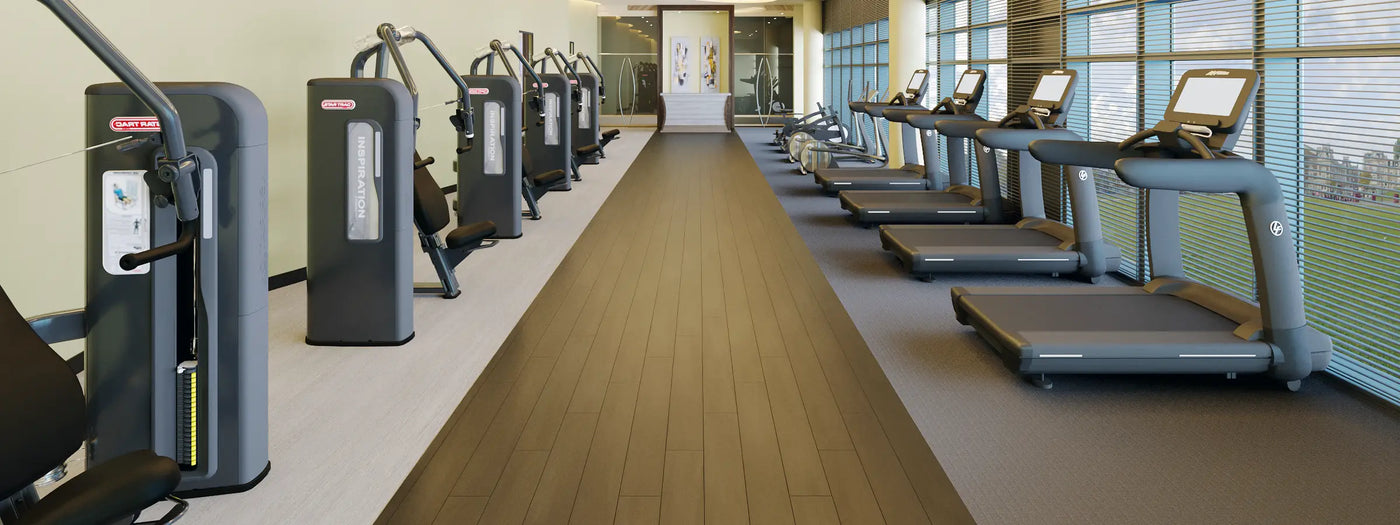
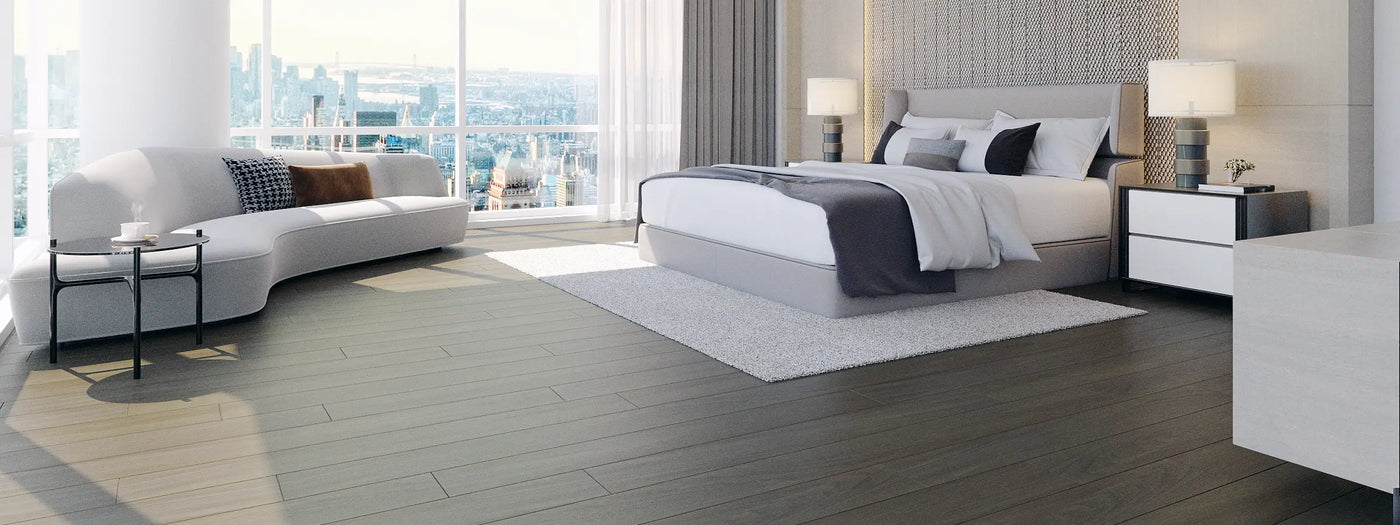
Same Plank Format as LVT — Different Floor Underneath

Both PVT and LVT use the “tile” classification for testing regardless of SKU format, so Heritage Motivate ships in the same 6″ x 48″ plank dimensions you’d spec from any commercial LVT manufacturer — and installs the same way: glue-down, no click-lock, no separate sound-control underlayment install (the 5mm VCR rubber base is factory-bonded).

The seven dimensions where PVT outperforms LVT are below. Then the four headline numbers behind those ratings. After that: vertical-specific applications. If you’re spec’ing commercial LVT and the floor goes into a space where ergonomics, acoustics, or fall safety matter, this is the upgrade path.

PVT vs Rigid LVT vs 2mm LVT — 7 Performance Pillars

ECORE's own product literature rates Performance Vinyl Tile (Heritage Motivate) against Rigid LVT and 2mm LVT across seven dimensions. PVT scores ECORE's top rating on every row. The dot ratings below are pulled directly from ECORE's PVT vs LVT cheat sheet — not Blue Sky's interpretation.

Performance Dimension PVT (Heritage Motivate) 7mm itsTRU Performance Vinyl Tile Rigid LVT Click-lock plank 2mm LVT Glue-down sheet / plank
Ease of Repair ••• Replace a single tile in place. No floor disassembly. Unclick the entire floor back to the damaged plank. Cut, patch, and re-seam.
Ergonomics ••• 5mm VCR rubber base provides force reduction underfoot. Walking on the subfloor — in most cases concrete. 2mm of vinyl over the subfloor. Minimal cushion.
Acoustics ••• IIC 56 built-in. 146% quieter than VCT/LVT (ECORE Lab Floors). •• Requires a separate sound-control underlayment install. Requires a separate sound-control underlayment install.
Safety ••• Surface absorbs ~10.6% of impact force on a fall. Falling on Rigid LVT is like falling on laminate or hardwood. Falling on 2mm LVT is like falling on 2mm sheet vinyl.
Installation ••• Glue-down. Sound-control underlayment fusion-bonded at the factory. •• Click-lock plank install plus a separate underlayment trade. Glue-down plus a separate underlayment trade.
Cost of Ownership ••• Comparable installed cost. Longer service life. No underlayment line item. •• Higher install labor (underlayment). Shorter service life. Higher install labor (underlayment). Shortest service life.
Durability ••• 21 mil PUR-reinforced wear layer. VCR base recovers from indentation. Plastic core. Indentations are permanent. Thin plastic. Wears fastest of the three.
  • Ease of Repair

    • PVT•••Replace a single tile in place.
    • Rigid LVTUnclick the entire floor.
    • 2mm LVTCut, patch, re-seam.
  • Ergonomics

    • PVT•••5mm VCR rubber force reduction.
    • Rigid LVTWalking on the subfloor.
    • 2mm LVT2mm of vinyl over subfloor.
  • Acoustics

    • PVT•••IIC 56 built-in. 146% quieter than LVT.
    • Rigid LVT••Separate underlayment install.
    • 2mm LVTSeparate underlayment install.
  • Safety

    • PVT•••Absorbs ~10.6% of impact force.
    • Rigid LVTLike falling on laminate or hardwood.
    • 2mm LVTLike falling on 2mm sheet vinyl.
  • Installation

    • PVT•••Glue-down. Underlayment factory-bonded.
    • Rigid LVT••Click-lock plus underlayment sub-trade.
    • 2mm LVTGlue-down plus underlayment sub-trade.
  • Cost of Ownership

    • PVT•••Comparable installed cost. Longer life.
    • Rigid LVT••Higher install labor. Shorter life.
    • 2mm LVTHigher install labor. Shortest life.
  • Durability

    • PVT•••21 mil PUR wear layer. VCR recovers.
    • Rigid LVTPlastic core. Indentations permanent.
    • 2mm LVTThin plastic. Wears fastest.

Good  ·  Better  ·  Best  —  ratings per ECORE’s PVT vs LVT product literature.

4 Numbers That Separate Heritage Motivate PVT From Standard LVT

The performance gap between PVT and standard commercial LVT is measured, not marketed. The four headline figures below are pulled from ECORE's PVT product literature and Lab Floors data sheet. Provenance and a free room-planning tool round out the panel.

  • 10.6% Force Absorption on Impact

    10.6% Force Absorption on Impact (opens in new tab)

    PVT's 5mm VCR rubber base absorbs roughly 10.6% of impact force on a fall. On standard LVT, the body absorbs nearly 100% of that impact. Per ECORE's PVT product literature: “Your surface will absorb approximately 10.6% of the force of impact, instead of your body absorbing almost 100% of that impact.”

  • IIC 56 Built-In

    IIC 56 Built-In

    Sound-control underlayment is fusion-bonded to the rubber base at the factory, not installed onsite as a separate sub-trade. Eliminates an underlayment line item on the install bid and a coordination headache on the site schedule.

  • 146% LVT Loudness Penalty

    146% LVT Loudness Penalty

    Per ECORE's Lab Floors data sheet, VCT and LVT generate a 146% increase in perceived loudness relative to fusion-bonded vinyl. Heritage Motivate measures 80 dB(A) sound power per ASTM E3133; standard LVT measures 90 dB(A); concrete measures 93 dB(A).

  • 21 Mil Commercial Wear Layer

    21 Mil Commercial Wear Layer

    A ‘mil’ is the flooring-industry unit for wear-layer thickness — 1 mil = 1/1000 of an inch. Industry context: residential LVT runs 6–12 mil, light commercial 12–20, full commercial 20+. Heritage Motivate’s PUR-reinforced 21 mil layer sits at the top of the commercial range. The VCR base also recovers from indentation rather than permanently deforming — per ECORE, “VCR inherently wants to return to its original shape and form, and it does not break down over time.”

  • Made in Lancaster, PA

    Made in Lancaster, PA

    Manufactured by ECORE International in Lancaster, Pennsylvania. Up to 65–67% post-consumer recycled content per the ECORE Lab Floors and Senior Care data sheets. Buy American Act / BABA documentation available on request — useful for federal, military, and public-sector RFPs.

  • Gym Layout Designer

    Free Gym Layout Designer (opens in new tab)

    Map the room before you commit. Useful for visualizing PVT plank coverage, equipment zones, and adjacency to wet areas (where HydroGrip Motivate is the call instead). Free to use.

10 FAQs About Performance Vinyl Tile (PVT) vs LVT

PVT is a 7mm plank built on a 5mm vulcanized composition rubber base; standard LVT is plastic over the subfloor. ECORE's Heritage Motivate PVT pairs a 2mm vinyl wear surface, fusion-bonded at the factory via itsTRU technology, to a 5mm VCR rubber base. Standard LVT — whether 2mm glue-down or 5mm Rigid click-lock — is plastic-only construction with no rubber backing.


The performance gap is in the construction. ECORE's product literature is direct: “Walking (or standing) on most LVT is like walking directly on the subfloor; which in a lot of cases is concrete.” PVT's VCR base absorbs roughly 10.6% of impact force on a fall, delivers IIC 56 built-in (no separate underlayment install required), and recovers from indentation rather than permanently deforming. Standard LVT does none of those three things.


ECORE's product class is “Performance Vinyl Tile” because the product is tested and rated as a tile-format flooring system, but the SKU you spec is a 6″ x 48″ plank. “Tile” here is the manufacturer's product-class label — the same way “LVT” (Luxury Vinyl Tile) is the umbrella class for plank-format products like commercial wood-look LVT.


If you've been shopping commercial vinyl plank, Heritage Motivate is in the same plank format you've been comparing — 6″ x 48″ planks, glue-down install, wood-look surface aesthetics. The difference is the rubber-backed substrate underneath the vinyl wear layer. Don't get hung up on the “tile” in PVT; the floor on the truck is plank.


Material cost is comparable; total installed cost can be lower because PVT eliminates the separate underlayment install. Standard commercial LVT for stacked-occupancy or acoustic-sensitive use cases typically requires a separate sound-control underlayment as a sub-trade install — that's an extra material line item and an extra labor line item on the bid. Heritage Motivate's sound-control layer is fusion-bonded to the rubber base at the factory.


Lifecycle cost favors PVT further. The VCR base recovers from indentation rather than permanently deforming, and the 21 mil PUR-reinforced wear layer is rated for full commercial traffic. Heritage Motivate carries a 10-year prorated warranty per the ECORE Warranty Guide. Every Blue Sky bulk quote lists materials, freight, installation (if requested), and the warranty term as separate line items so the comparison is honest.


10 years prorated, original purchaser only, per the ECORE Warranty Guide. The prorated schedule covers 100% of the product cost in years 1–6, 60% in year 7, 40% in year 8, 30% in year 9, and 20% in year 10. The same 10-year prorated term applies to ECORE's Bounce 2, Baller, Balanced, Restorative, and Serenity Class I vinyl lines.


Damage claims go through Blue Sky as your authorized ECORE Athletic dealer — you don't go direct to the factory. We file the claim with ECORE on your behalf and manage the resolution. We list the applicable warranty term on the quote and flag any exclusions specific to the install upfront.


Yes — concrete is the most common subfloor for Heritage Motivate, and PVT was engineered with a concrete subfloor as the design assumption. Install method is glue-down with ECORE's E-Grip III polyurethane adhesive over a clean, level, moisture-tested concrete slab. The 5mm VCR rubber base is what gives you the cushion and acoustic performance LVT can't deliver over the same slab.


Wood-frame subfloor and existing tile or vinyl substrates are also supported with appropriate prep. Subfloor moisture testing per ASTM F2170 (relative humidity) or F1869 (calcium chloride) is required ahead of install — this is true for any glue-down vinyl product. Send Blue Sky a copy of the subfloor scope and we'll spec the prep against ECORE's install tech manual.


Significantly. Heritage Motivate measures ΔIIC 23 dB per ASTM E2179; standard LVT measures 3 dB and heterogeneous sheet vinyl 8 dB. The single biggest acoustic differentiator on the spec sheet. Heritage Motivate also carries IIC 53 (per ASTM E492), STC 52 (per ASTM E90), and an 80 dB(A) sound power level (per ASTM E3133) — vs 90 dB(A) for LVT and 93 dB(A) for bare concrete.


Per ECORE's Lab Floors data sheet, VCT and LVT generate a 146% increase in perceived loudness relative to itsTRU fusion-bonded products. For senior living, multifamily, and any stacked-occupancy use case, the acoustic gap is the spec gap. Standard LVT can be brought partway there with a separate sound-control underlayment, but that's a second sub-trade install — PVT's underlayment is fusion-bonded at the factory.


PVT is ECORE's “Best”-rated product for Group/Dance, Spin, Yoga, Cardio, Senior Care, Offices, Therapy/Rehab, Living Spaces, K-12, Retail, Public Spaces, and Clinical/Labs. Standard LVT may still pencil for low-traffic back-of-house corridors, utility rooms with dry-only exposure, and spaces where ergonomics, acoustics, and fall safety are not in the spec brief.


For wet areas (locker rooms, restrooms, pool decks), neither standard LVT nor Heritage Motivate is the call — ECORE's HydroGrip Motivate is the wet-zone product. We're glad to walk through the use-case-by-use-case rating in ECORE's product literature on a sample-and-quote call.


Three differences: it's bonded to the wear surface at the factory, it provides force reduction underfoot in addition to acoustic isolation, and it doesn't add a labor line item. Sound-control underlayment installed under standard LVT is a separate roll product, installed by a separate trade, on a separate day in the schedule. PVT's VCR base ships fusion-bonded to the vinyl — one product, one install.


The VCR base also does work the underlayment can't. Per ECORE: “VCR inherently wants to return to its original shape and form, and it does not break down over time.” That recovery property is what gives PVT its ergonomic performance underfoot — not just sound isolation, but force reduction under standing, walking, and fall loads. A standard sound-control underlayment under LVT addresses the acoustic line item; the VCR base addresses ergonomics, acoustics, and safety in one assembly.


Yes — manufactured in Lancaster, Pennsylvania. ECORE International runs its production from Lancaster, where the company diverts roughly 112 million pounds of recycled commercial truck tires from landfill annually per ECORE's Lab Floors data sheet. Heritage Motivate carries up to 65–67% post-consumer recycled content per ECORE's Lab Floors and Senior Care data sheets.


For ownership groups managing ESG and supply-chain reporting at the portfolio level, domestic manufacture is a clean line item on the FF&E disclosure. Buy American Act / BABA documentation is available from ECORE on request — useful for federal, military, and public-sector RFPs. We'll request the documentation pack from ECORE on any project that needs it.


Free samples ship FedEx Ground, typically 1 week to delivery, no per-request quantity limit. Bulk quotes return in 1 business day with materials, LTL freight (liftgate included by default), and installation (on request) priced as separate line items. Standard ECORE lead time is 4–6 weeks; custom-color and water-jet inlay work runs 5–7 weeks. Quicker 1–3 day options exist on certain in-stock colors and locations — ask us to check on the specific spec.


Request a sample at /pages/request-sample or a bulk quote at /pages/request-bulk-quote. Damage claims go through Blue Sky — we file with ECORE on your behalf as the authorized dealer. Net-30 terms available; tax-exempt processing supported with a valid certificate; W-9 and EIN provided on request.

Need a technical definition? Browse the ECORE Athletic Flooring Glossary

Need spec sheets, tech manuals, or LEED docs for your bid package? Open the ECORE Technical Resources Library