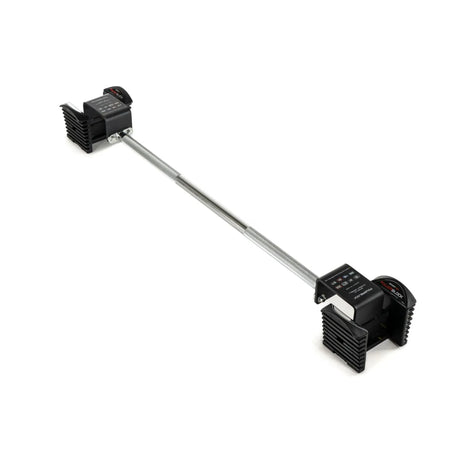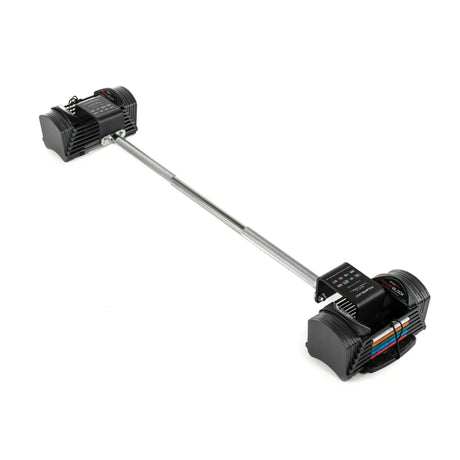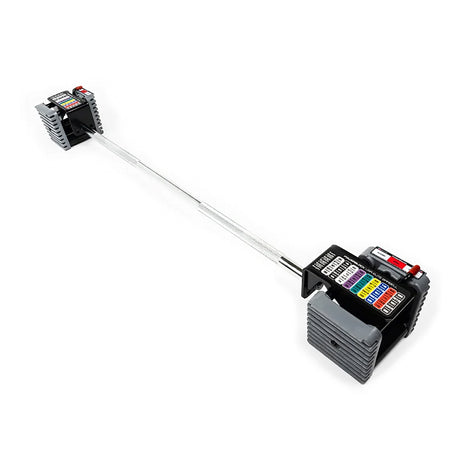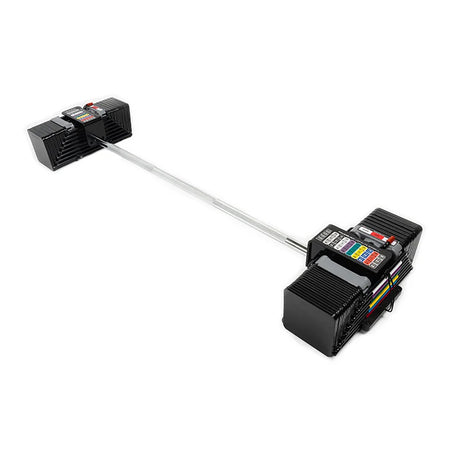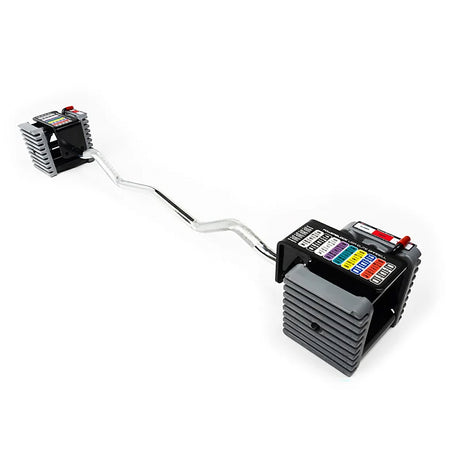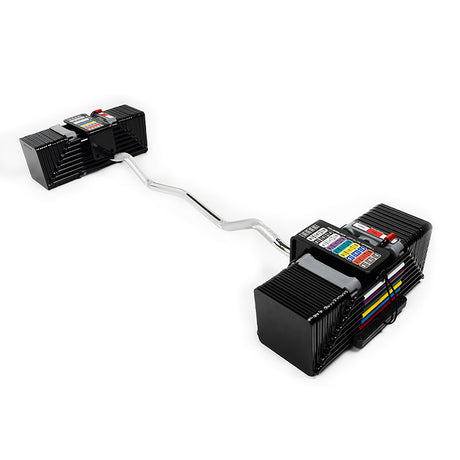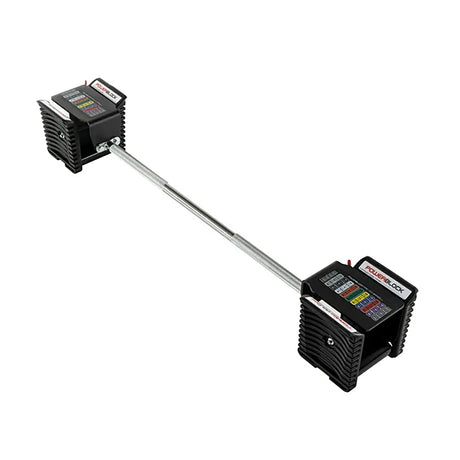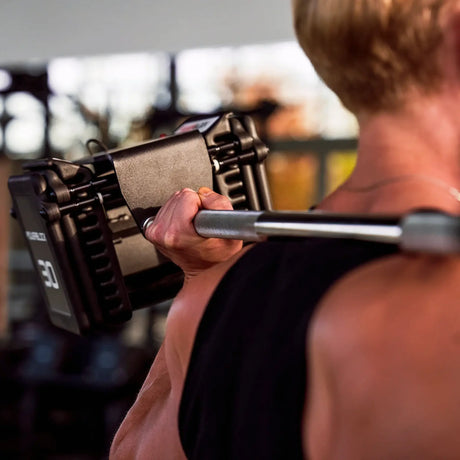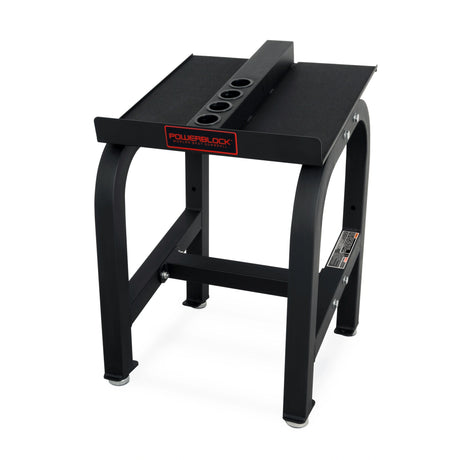


Commercial gyms, school weight rooms, and corporate wellness centers are rethinking free weight storage. Space is shrinking, budgets are tightening, and the days of 20-pair fixed dumbbell racks consuming an entire wall are numbered for a lot of facilities. Adjustable dumbbells have moved from home gym novelty to a legitimate line item on commercial procurement spreadsheets — and two brands dominate that conversation: PowerBlock and Bowflex.
Here's the uncomfortable truth about most PowerBlock vs Bowflex comparisons you'll find online: they're written for home gym users. Someone furnishing a basement. Someone who lifts three times a week solo.
That's not you. If you're a gym owner, school athletic director, hotel facilities manager, or corporate wellness coordinator, you need this comparison filtered through an entirely different set of criteria — how does each system hold up under 40 users a day, what does the warranty actually cover in a commercial setting, and what does the math look like when you're buying 10 pairs instead of one? This post covers exactly that: design philosophy, weight range, durability, commercial suitability, price per pound of resistance, and a head-to-head commercial dumbbell comparison built for buyers making fleet decisions.
PowerBlock has manufactured adjustable dumbbells since 1991 and holds multiple U.S. patents on its selector-pin block design — that's over 30 years of iterative engineering in the commercial space. Bowflex's SelectTech line launched in the early 2000s using a fundamentally different dial-based selector mechanism. Both systems work. Both have loyal followings. But the adjustable dumbbell market is projected to grow significantly through the mid-2020s, driven largely by space-constrained commercial facilities and hybrid gym models — and that growth is putting serious stress-testing pressure on both platforms in ways home use never did.
What follows is a B2B buyer's guide to choosing between these two systems. No fluff, no affiliate bias — just an honest breakdown of what each brand delivers and where each one falls short when the stakes are commercial.
Table of Contents:
- PowerBlock vs Bowflex: Core Design Philosophy and How Each System Actually Works
- Weight Range, Increments, and Expandability: Where PowerBlock vs Bowflex Diverge Most
- Durability, Commercial Use, and the Real Cost of Ownership for PowerBlock vs Bowflex
- Head-to-Head Comparison: PowerBlock vs Bowflex by Use Case
- PowerBlock vs Bowflex: Full Feature Comparison Table
- Frequently Asked Questions: PowerBlock vs Bowflex
- The Verdict: Choosing the Right Adjustable Dumbbell System for Your Facility
PowerBlock vs Bowflex: Core Design Philosophy and How Each System Actually Works
Start with the mechanism, because everything downstream — durability, adjustment speed, ergonomics, failure modes — traces back to how the selector system is built.
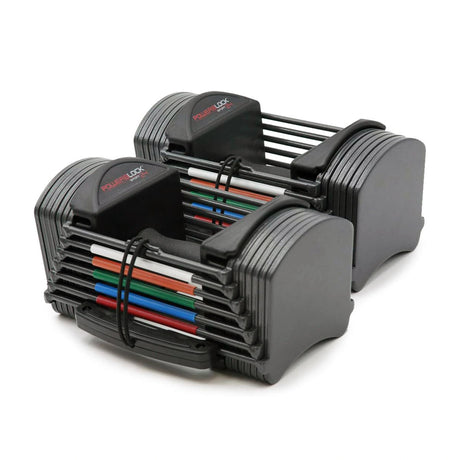
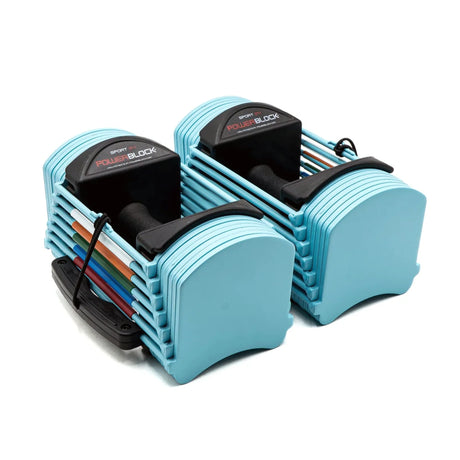
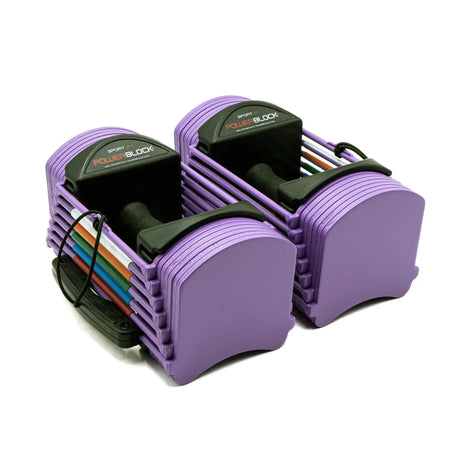
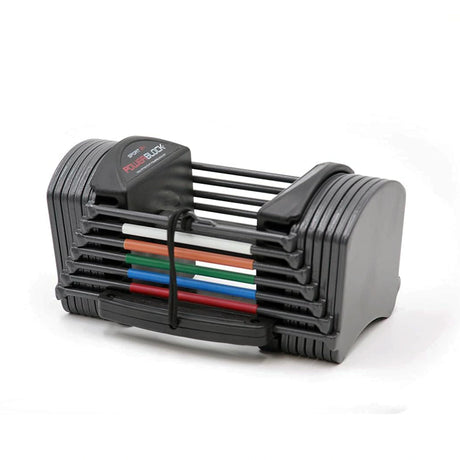
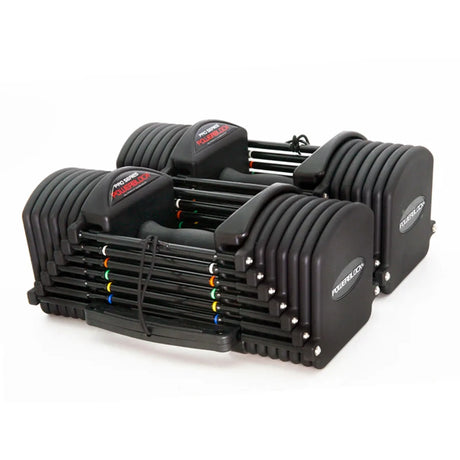
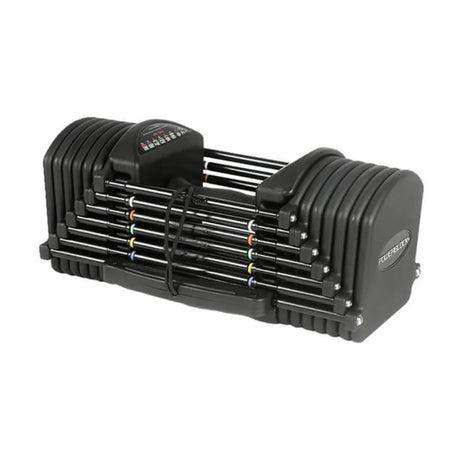
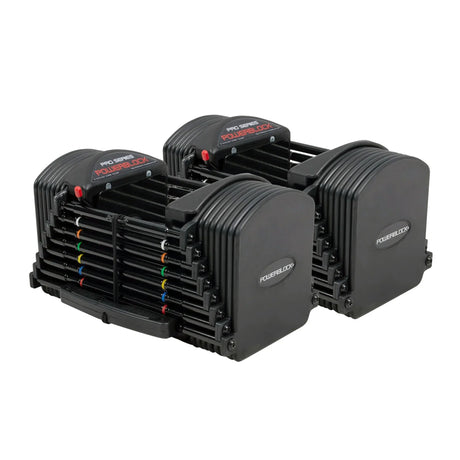
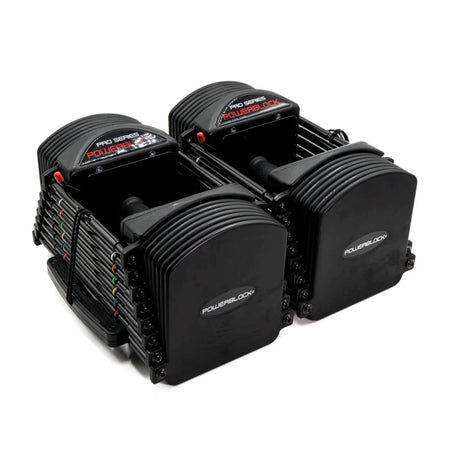
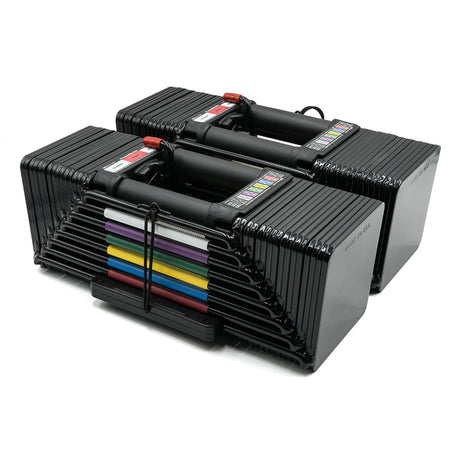
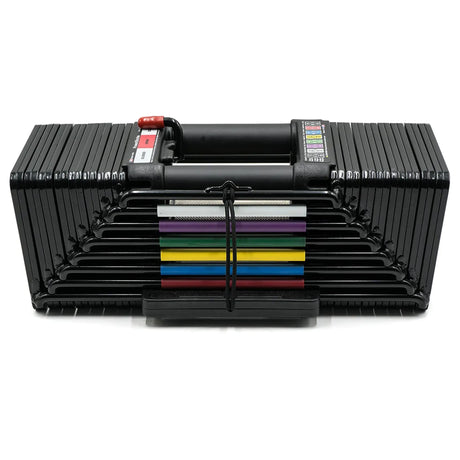
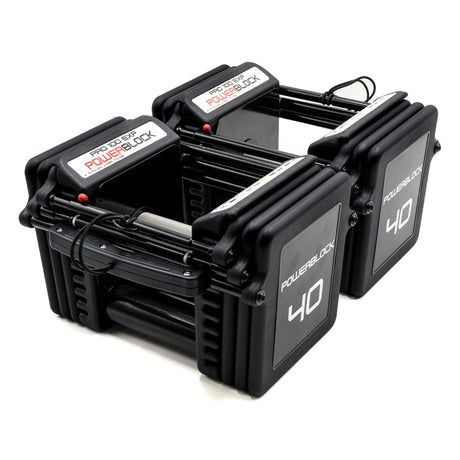
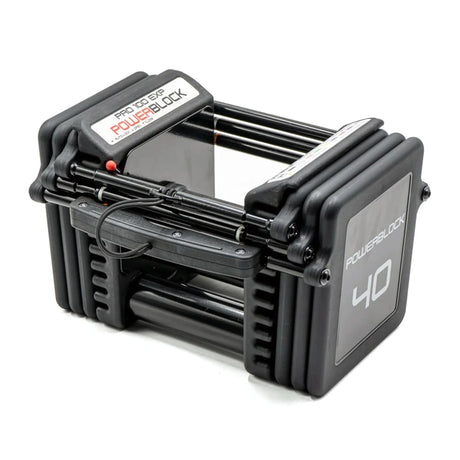
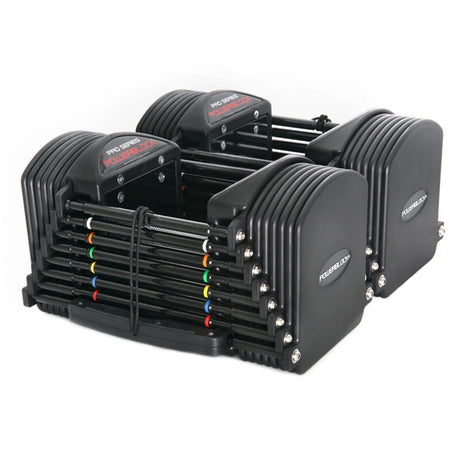
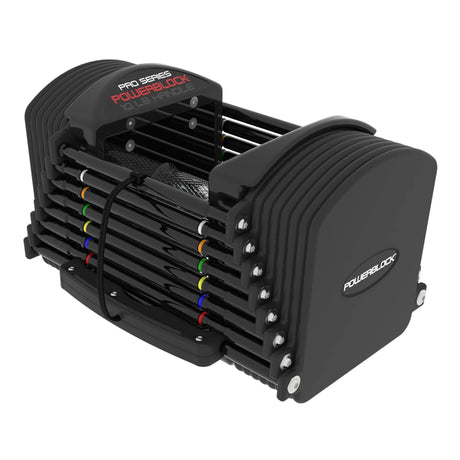
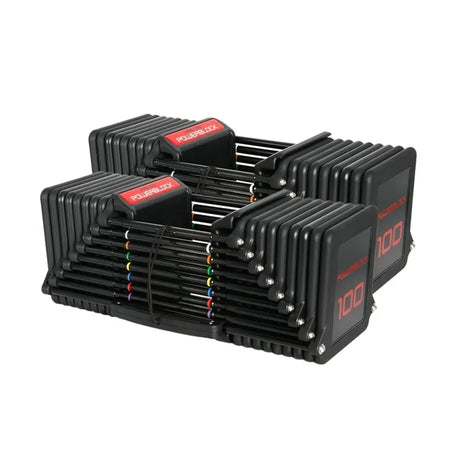
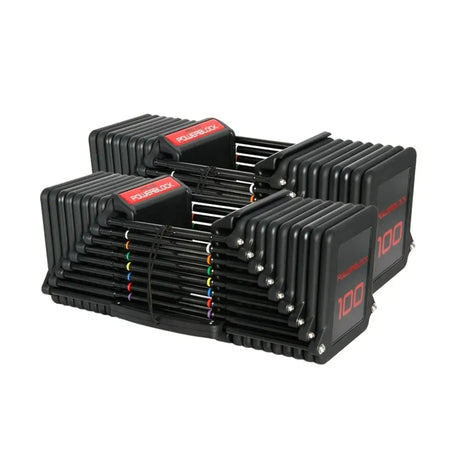
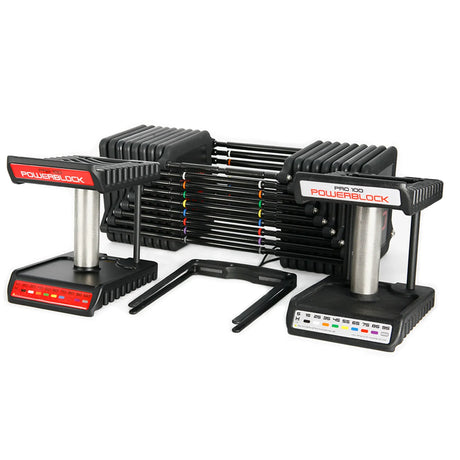
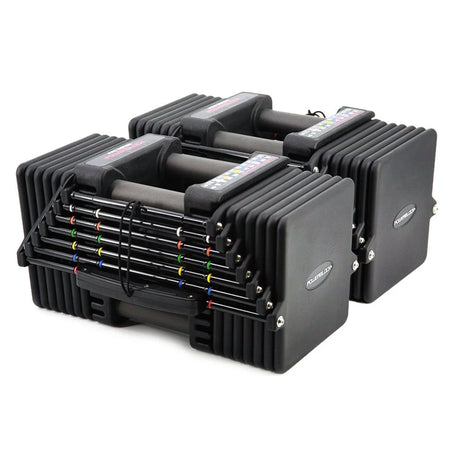
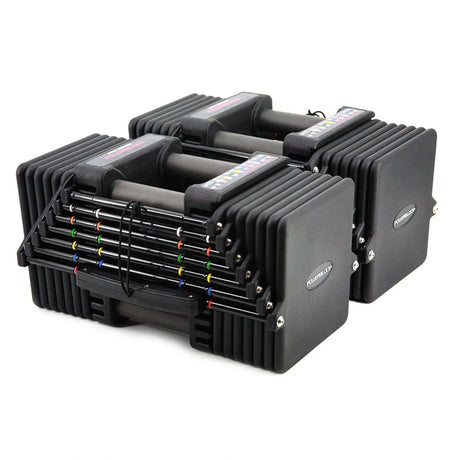
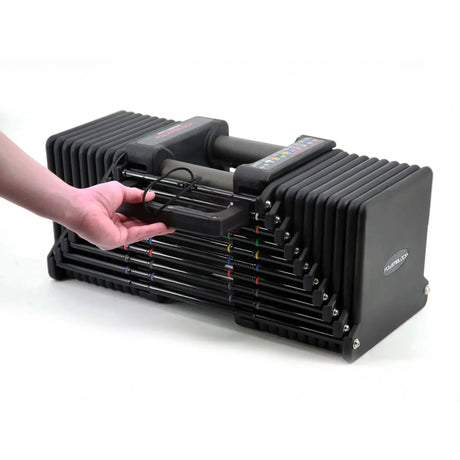
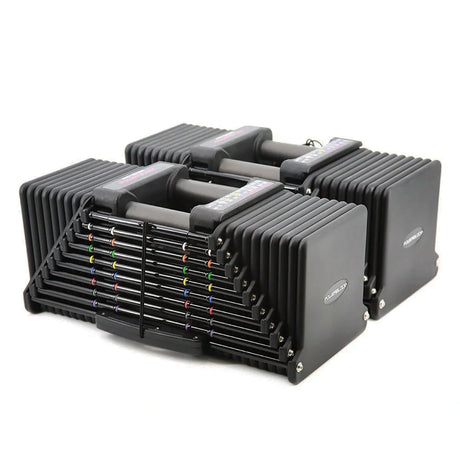
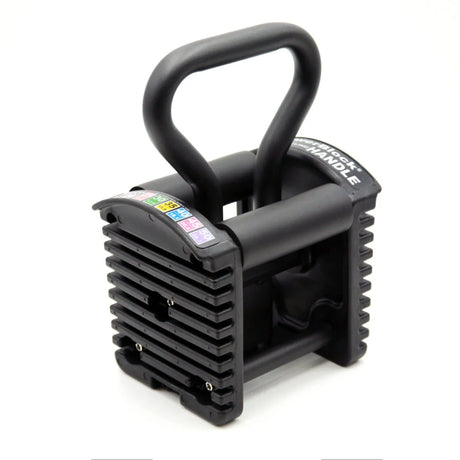
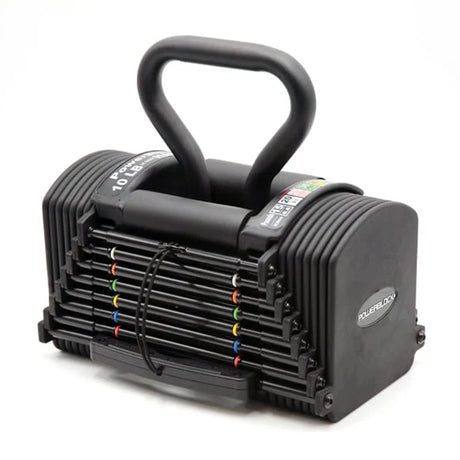
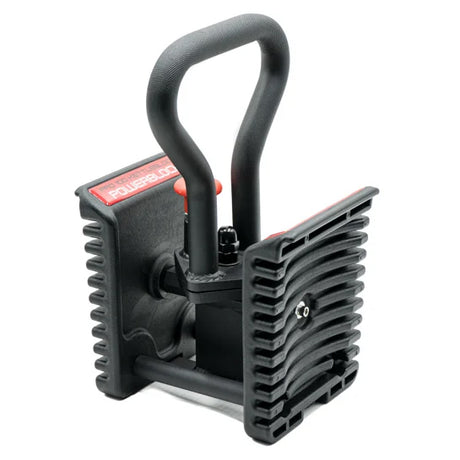
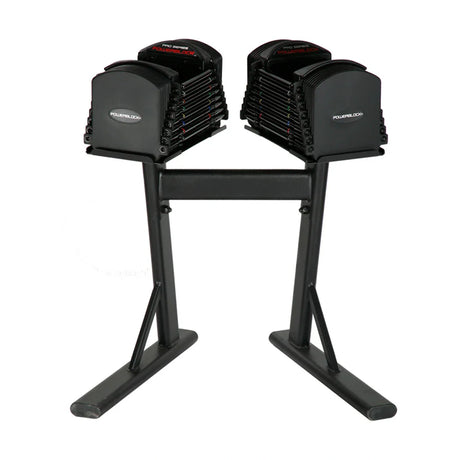
PowerBlock's system uses interlocking weight blocks nested inside a steel cage frame. A selector pin slides into a designated slot, and when you lift the handle, the pin catches only the blocks below that slot — leaving the rest in the cradle. The result is a compact cube-shaped dumbbell that grows heavier as you add more blocks. This selector pin mechanism is protected by multiple U.S. patents dating to the early 1990s, and the design has changed relatively little in three decades because it simply works. Adjustment takes 2–3 seconds: pull the pin, reinsert it at the new slot, done.
Bowflex SelectTech uses a rotating dial at each end of the bar. Turn the dial to the desired weight, and internal teeth disengage the unwanted plates from the handle — the selected plates lock to the bar, the rest stay in the cradle. The Bowflex SelectTech 552 adjusts in 2.5 lb increments from 5 to 52.5 lbs; the SelectTech 1090 adjusts in 5 lb increments from 10 to 90 lbs. The SelectTech 560 adds Bluetooth connectivity and app integration for logged workouts. The mechanism produces a traditional dumbbell shape — a longer, horizontal profile that most lifters find familiar and natural in the hand.
The ergonomic implications of these two form factors matter more than most buyers anticipate. Bowflex's shape mimics a fixed dumbbell closely, which means exercises like lateral raises, skull crushers, and concentration curls feel intuitive. PowerBlock's cage profile is noticeably different — the open frame sits around your hand rather than below it, and some lifters find it awkward for movements where the dumbbell needs to rotate freely near the body. That's a real trade-off, not marketing spin. In a commercial setting with diverse users, expect some complaints about the PowerBlock cage from members who are used to traditional dumbbell shapes.
Adjustment speed is where the selector pin pulls clear ahead. PowerBlock's single-pin system averages 2–3 seconds per weight change. Bowflex's dual-dial system — you must turn both ends to matching weights simultaneously — averages 5–8 seconds when both dials are dialed in correctly, and longer when they're misaligned. In a personal training studio where a trainer is cycling a client through supersets with different weights on each exercise, that difference adds up over a 60-minute session.
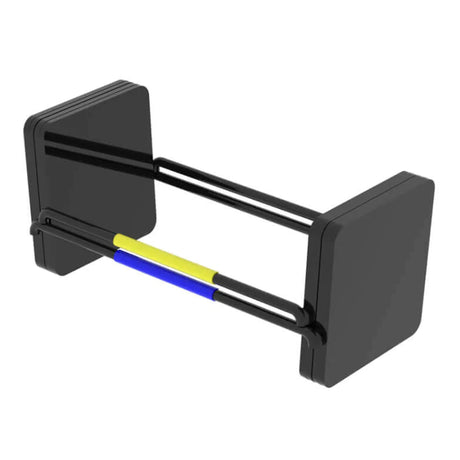
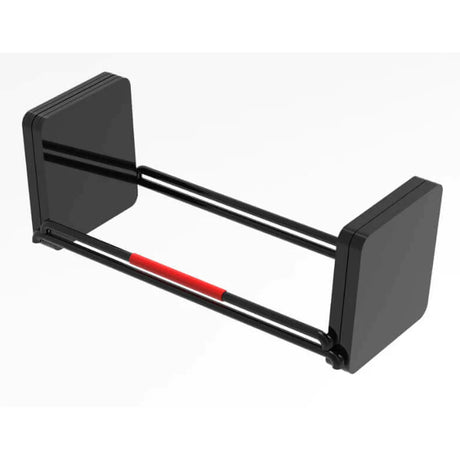
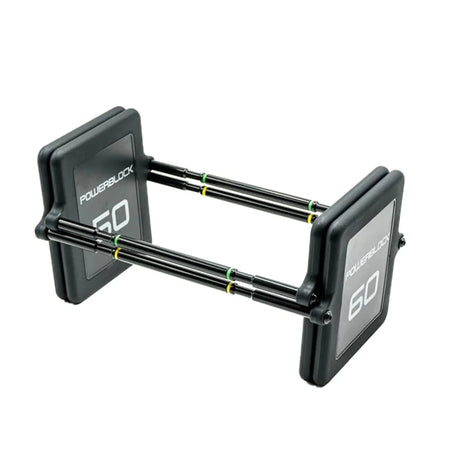
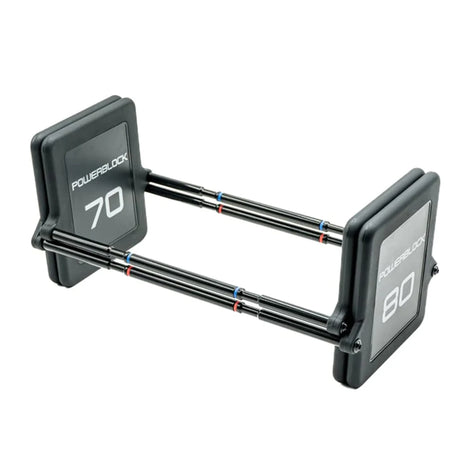
One commercial differentiator that rarely gets enough attention: PowerBlock's EXP series is modular. The PowerBlock Pro EXP and Elite EXP start at Stage 1 (5–50 lbs) and accept add-on weight kits to reach Stage 2 (5–70 lbs) and Stage 3 (5–90 lbs). You buy the base unit now, expand later when budget allows. Bowflex offers no equivalent — the SelectTech 552 is a 552, and the 1090 is a 1090. Fixed ranges, fixed price points, no upgrade path. For a deeper look at how the Elite series stacks up in practice, the PowerBlock Elite review on the Blue Sky blog covers the real-world performance details worth reading before you finalize a spec.
PowerBlock currently offers four primary series: Sport, Elite, Pro, and EXP. Bowflex offers the SelectTech 552, 560, 840 (a kettlebell-style unit), and 1090. PowerBlock's Pro EXP Stage 3 reaches 90 lbs per hand; the Elite EXP Stage 3 also reaches 90 lbs with expansion kits. PowerBlock's compact cube footprint occupies approximately 50% less floor space than an equivalent traditional fixed dumbbell rack — a meaningful number when you're planning a school weight room or hotel fitness center where every square foot costs money.
Weight Range, Increments, and Expandability: Where PowerBlock vs Bowflex Diverge Most
Weight range and increment granularity are the specs commercial buyers should spend the most time on — because the right answer depends entirely on who is using the equipment and how.
Here's the full lineup breakdown:
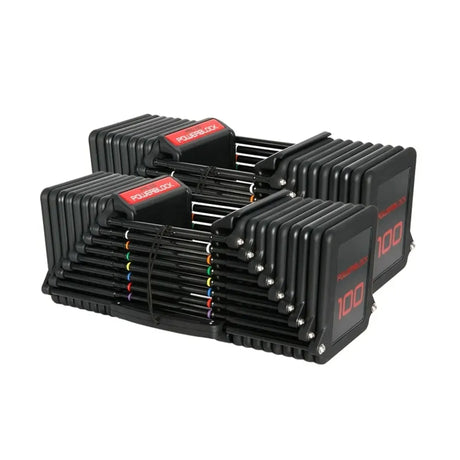
PowerBlock lineup: Sport 24 (5–24 lbs), Sport 50 (3–50 lbs), Elite EXP Stage 1–3 (5–50 to 5–90 lbs expandable), Pro EXP Stage 1–3 (5–50 to 5–90 lbs expandable), Pro 100 (5–100 lbs fixed). Increments run 2.5 lbs at the lower weight settings and 5 lbs at higher settings.
Bowflex lineup: SelectTech 552 (5–52.5 lbs, 2.5 lb increments at the low end), SelectTech 840 (8–40 lbs in 5 lb increments, kettlebell-style), SelectTech 1090 (10–90 lbs, 5 lb increments throughout), SelectTech 560 (5–60 lbs with Bluetooth app integration).
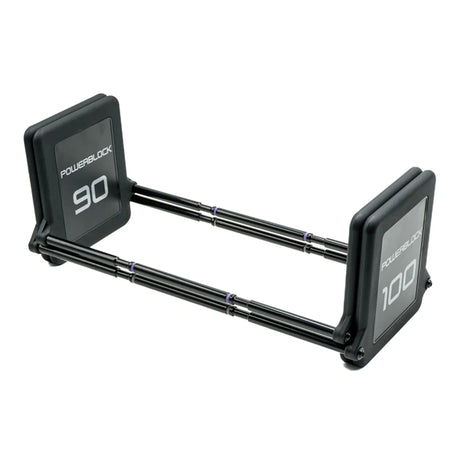
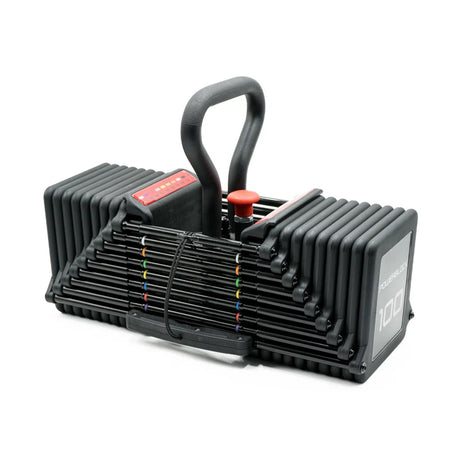
The PowerBlock Commercial Pro 100 reaches 100 lbs per hand, making it the heaviest commercially available adjustable dumbbell in its form factor category — nothing in the Bowflex SelectTech lineup comes close. The Bowflex SelectTech 1090 is rated to 90 lbs per hand with 5 lb increments, which makes it the closest direct competitor to the PowerBlock Pro EXP Stage 3 in the heavy end of the market.
The expandability gap is significant for school weight room dumbbells and similar institutional procurement scenarios. When school athletic directors ask which adjustable dumbbell to spec for a new weight room, PowerBlock's EXP series is almost always the answer — you can start with Stage 1 and expand the same units as the program grows and budget allows, rather than buying an entirely new set. A school that opens a new fitness center with a $15,000 equipment budget can buy PowerBlock EXP Stage 1 units now and upgrade to Stage 3 in year two without replacing the base hardware. Bowflex simply doesn't offer that flexibility.
The 5 lb versus 2.5 lb increment question has a nuanced answer in commercial settings. Physical therapy annexes, senior fitness centers, and rehabilitation-adjacent facilities genuinely benefit from 2.5 lb increments — the difference between 10 lbs and 12.5 lbs matters when you're programming progressive overload for a 68-year-old post-surgical patient. Athletic training rooms and performance weight rooms, on the other hand, rarely use anything below 25 lbs and almost never need finer than 5 lb jumps at the heavy end. Know your user population before you lock in on this spec.
The PowerBlock EXP expansion kits — sold separately — allow a Stage 1 unit (5–50 lbs) to reach Stage 2 (5–70 lbs) and Stage 3 (5–90 lbs) without replacing the base unit. This is a genuine cost advantage for facilities managing rolling capital expenditure budgets. You're not throwing away the original purchase; you're building on it. The PowerBlock Elite USA 90 Stage 2 Expansion Kit is a practical example of how that upgrade path works in the field — facilities buy Stage 1, then add Stage 2 when the budget cycle allows.
For facilities that need to serve serious strength athletes above 70 lbs per hand, the comparison narrows to Bowflex SelectTech 1090 versus PowerBlock Pro EXP Stage 3. Both reach 90 lbs. Both use 5 lb increments at the heavy end. The divergence — and it's a significant one — shows up not in the spec sheet but in how each system handles that weight under daily commercial load. That's the durability conversation, and it changes the entire calculus on adjustable dumbbells commercial buyers should be having.

Durability, Commercial Use, and the Real Cost of Ownership for PowerBlock vs Bowflex
This is the section that matters most if you're buying for a facility rather than a spare bedroom.
Home-grade durability specs do not translate to commercial multi-user environments. A Bowflex SelectTech 1090 used by one person doing four sessions a week will hold up for years. That same unit in a commercial gym serving 40 users daily is a different product in a different stress environment — and the spec sheet won't warn you about that.
PowerBlock's commercial construction reflects its institutional history. The Pro and Elite series use steel selector pins, urethane-coated weight blocks, and a welded steel cage frame. The PowerBlock Pro series carries a 10-year warranty on the frame and a 2-year warranty on parts for commercial applications. That warranty isn't a marketing footnote — it reflects the actual expected service life of the product under professional use conditions. PowerBlock units have been deployed in hotel gyms, university weight rooms, and military fitness facilities, all of which are documented commercial environments with high daily use cycles.
Bowflex SelectTech construction is built around ABS plastic housing. The dial selectors — the central mechanical component of the entire system — are plastic. The product documentation from Bowflex states explicitly that SelectTech units are designed for home use. No commercial warranty is offered on SelectTech lines. This is not a technicality buried in fine print — it's a deliberate product positioning decision by the manufacturer that tells commercial buyers everything they need to know about the intended use environment.
The practical failure modes are worth spelling out clearly. Bowflex's plastic dials crack or strip under repeated high-frequency use. More concerning: the plates can disengage mid-lift if the selector isn't perfectly aligned — a real safety issue in a commercial setting where not every user reads the instruction card mounted on the cradle. A weight releasing unexpectedly at 70 lbs isn't just an equipment problem; it's a liability event. PowerBlock's failure modes are less dangerous: the selector pin can bend if the unit is dropped aggressively, and the cage frame can dent. Those failures are far less frequent than Bowflex dial failures under comparable load, and neither creates an acute safety hazard the way a disengaged plate does.
The total cost of ownership math is where the initial price advantage of Bowflex dissolves. A Bowflex 1090 pair runs approximately $600–700 at retail. A PowerBlock Pro EXP Stage 3 pair runs approximately $800–1,000. Over a five-year commercial lifecycle in a busy facility, Bowflex units in high-traffic environments can require replacement in 18–24 months — sometimes sooner. Two replacement cycles on Bowflex pairs exceeds the original cost of PowerBlock units by a meaningful margin, before you even factor in the labor and downtime costs of pulling broken equipment.
As a B2B distributor, Blue Sky carries PowerBlock specifically because facilities managers have come back to us after burning through Bowflex units in 18–24 months under commercial load. The initial price savings evaporate fast when you're replacing equipment. We stock PowerBlock because we've seen it hold up in hotel gyms, university weight rooms, and training studios over multi-year spans. That's not brand loyalty — that's pattern recognition from watching commercial equipment cycles play out in real facilities.
The adjustable dumbbell durability gap between these two brands is not subtle in commercial settings. It's the difference between a 10-year asset and a 2-year consumable.

Head-to-Head Comparison: PowerBlock vs Bowflex by Use Case
Specs tell part of the story. Use cases close it out. Here's how each system performs across the facility types that make up most commercial dumbbell comparison decisions.
School and University Weight Rooms: PowerBlock is the clear recommendation. The expandability of the EXP series matters here — school programs grow, student athlete populations change, and budget cycles are rarely aligned with equipment needs. The commercial warranty is essential when the equipment is going to be used by 200 students across multiple class periods daily. School weight room dumbbells need to survive abuse that would retire most home-grade equipment within a semester. PowerBlock's steel construction holds up; Bowflex's plastic dials don't.
Hotel and Hospitality Fitness Centers: PowerBlock wins on compact footprint and commercial warranty for most hotel properties. A Marriott-branded fitness center running 18 hours of guest access daily needs commercial-grade equipment with a warranty that reflects that use case — PowerBlock units have been deployed in Marriott properties specifically for this reason. The exception: a small boutique hotel with a 200-square-foot gym seeing 5–8 guests per day might reasonably choose Bowflex SelectTech 552 pairs for their lower price point and traditional dumbbell aesthetic. In that very low-traffic scenario, Bowflex may outlast its value cycle before the dial failures become a problem.
Corporate Wellness Centers: PowerBlock is the safer fleet purchase for most corporate installations. However, a corporate wellness room in a 50-person company headquarters where the gym sees 10–15 users per day is meaningfully different from a 500-person campus fitness center. For genuinely low-traffic corporate installations, Bowflex SelectTech 552 or 560 pairs can work within their design constraints. Budget-dominant decisions in that context are defensible — just go in with clear eyes about the warranty gap.
Personal Training Studios: PowerBlock Pro or Elite EXP is the unambiguous answer. Trainers cycle clients through exercises constantly, weight changes happen every 60–90 seconds across a full session, and the selector pin's 2–3 second adjustment time versus the dual-dial's 5–8 seconds compounds into meaningful session efficiency differences. PowerBlock's selector pin adjustment time averages 2–3 seconds per weight change versus Bowflex's dual-dial system averaging 5–8 seconds — across 30 weight changes in a circuit training session, that's two to three minutes of dead time with Bowflex. In a revenue-generating training environment, that matters. Facilities building out a full commercial free weight area will find useful context in the PowerBlock Dumbbells 90 review, which covers how the heavy-end adjustable dumbbell lineup performs under serious lifting loads.
Home Gym (for completeness): Bowflex is genuinely more competitive here, and saying otherwise would be dishonest. The lower price point, traditional dumbbell ergonomics, and lighter daily use cycles all favor Bowflex for solo home users lifting three to five times a week. The PowerBlock cage form factor is an acquired taste, and if you're the only user and you're not lifting at commercial volume, the durability premium of PowerBlock is real money that may not pay off within a reasonable ownership window. For home use, buy what you'll enjoy using.
For B2B buyers, the PowerBlock vs Bowflex question is largely settled by the commercial warranty gap before any other factor enters the analysis.

PowerBlock vs Bowflex: Full Feature Comparison Table
The table below covers the decision-relevant specifications for the two most direct commercial competitors: the PowerBlock Pro EXP (Stage 3) and the Bowflex SelectTech 1090.
| Feature | PowerBlock Pro EXP (Stage 3) | Bowflex SelectTech 1090 |
|---|---|---|
| Weight Range | 5–90 lbs | 10–90 lbs |
| Weight Increments | 2.5 lbs (lower) / 5 lbs (upper) | 5 lbs throughout |
| Selector Mechanism | Steel selector pin (patented block system) | Dual rotating ABS plastic dials |
| Construction Material | Steel frame, urethane-coated weight blocks | Steel plates, ABS plastic dial housing |
| Adjustment Speed | 2–3 seconds | 5–8 seconds |
| Expandability | Yes — Stage 1 to Stage 2 to Stage 3 via add-on kits | No — fixed range, no upgrade path |
| Commercial Warranty | 10-year frame / 2-year parts | None — residential use only |
| Residential Warranty | Included | 2-year parts / 1-year labor |
| Approximate Retail Price (per pair) | $900–$1,000 | $600–$700 |
| Recommended Use Setting | Commercial — gyms, schools, hotels, studios | Residential / very low-traffic commercial |
| Form Factor / Footprint | Compact cube — ~50% smaller than equivalent fixed rack | Traditional dumbbell profile — longer horizontal footprint |
| Max Weight Per Hand | 90 lbs (Stage 3) / 100 lbs (Pro 100) | 90 lbs |
For commercial facilities, the warranty and durability columns alone settle the debate.

Frequently Asked Questions: PowerBlock vs Bowflex
1. Is PowerBlock or Bowflex better for a commercial gym?
PowerBlock is the better choice for commercial gyms in virtually every scenario. PowerBlock's Pro and Elite series are built with steel frames, urethane-coated weight blocks, and a patented steel selector pin mechanism, and carry a 10-year commercial frame warranty. Bowflex SelectTech is explicitly designed and warranted for residential use only, with ABS plastic dial selectors that are the most common failure point under high-frequency multi-user load. Any facility with more than a handful of daily users should default to PowerBlock on both durability and liability grounds.
2. Can Bowflex SelectTech dumbbells be used in a commercial setting?
Bowflex SelectTech units can physically be placed in a commercial facility, but they carry no commercial warranty. Bowflex's product documentation explicitly positions SelectTech as a residential product, meaning the facility assumes full replacement liability from day one. In high-traffic environments where the plastic dial selectors are engaged dozens of times daily by varying users, failure timelines are significantly shorter than most operators anticipate — often 18 to 24 months before replacement is required.
3. How much weight does PowerBlock go up to?
PowerBlock's heaviest standard model, the Commercial Pro 100, reaches 100 lbs per hand. The PowerBlock Pro EXP at Stage 3 and the Elite EXP at Stage 3 each reach 90 lbs per hand via expansion kits. Bowflex's heaviest model, the SelectTech 1090, tops out at 90 lbs per hand. For facilities that need to serve advanced strength athletes, PowerBlock's 100 lb ceiling is a meaningful advantage over anything in the Bowflex lineup.
4. Are PowerBlock dumbbells expandable for school or institutional use?
Yes, and expandability is one of PowerBlock's strongest selling points for school and institutional buyers. The EXP series allows a Stage 1 unit (5–50 lbs) to be upgraded to Stage 2 (5–70 lbs) or Stage 3 (5–90 lbs) by purchasing add-on kits — no new base unit required. This lets schools and facilities align equipment investment with phased budget cycles, preserving the original purchase rather than replacing it. Bowflex offers no equivalent upgrade path on any SelectTech model.
5. Which adjustable dumbbell adjusts faster — PowerBlock or Bowflex?
PowerBlock's single selector pin adjusts in approximately 2 to 3 seconds. Bowflex's dual-dial system, which requires turning matching dials at both ends of the bar simultaneously, averages 5 to 8 seconds under normal conditions and longer when dials are misaligned. In a personal training studio running circuit sessions with frequent weight changes, that difference compounds into two to three minutes of dead time per session — a meaningful efficiency gap in a revenue-generating environment.
6. What is the total cost of ownership difference between PowerBlock and Bowflex in a commercial gym?
Over a five-year commercial lifecycle, PowerBlock typically delivers lower total cost of ownership despite higher upfront price. Bowflex SelectTech 1090 pairs retail at approximately $600 to $700, while PowerBlock Pro EXP Stage 3 pairs run approximately $900 to $1,000. However, Bowflex units in busy commercial environments often require replacement in 18 to 24 months, meaning two replacement cycles can exceed the original PowerBlock investment before year four — without factoring in the labor and downtime costs of swapping broken equipment mid-operation.
7. Which adjustable dumbbell is better for a hotel fitness center?
PowerBlock is the better choice for most hotel fitness centers, primarily because of its compact footprint and commercial warranty coverage. Hotel gyms running 16 to 18 hours of daily guest access need equipment with a warranty that reflects that use intensity, and PowerBlock Pro units have documented deployment in major hotel brands for exactly this reason. The one exception is a very small boutique property with minimal daily traffic — in that specific scenario, Bowflex SelectTech 552 pairs at a lower price point may reach end-of-value before mechanical failure becomes an issue.
8. Do PowerBlock dumbbells work for beginners and advanced lifters in the same facility?
Yes, PowerBlock's EXP and Pro series cover a wide enough range to serve both beginner and advanced users from a single set of equipment. The Pro EXP starts at 5 lbs and reaches 90 lbs at Stage 3, with 2.5 lb increments at the lower end for new or rehabilitating users and 5 lb increments at the heavier end for advanced athletes. This range makes PowerBlock one of the most versatile single-platform solutions for mixed-population commercial facilities like corporate wellness centers, hotel gyms, and school weight rooms.
The Verdict: Choosing the Right Adjustable Dumbbell System for Your Facility
For commercial and institutional buyers, this comparison has a clear answer: PowerBlock. The steel construction, patented selector pin mechanism, commercial warranty structure, and modular expandability all align with what professional facilities actually need from adjustable dumbbells commercial deployments. PowerBlock has been in commercial fitness production since 1991 — over 30 years of iterative engineering in real-world institutional environments, not just home gym settings.
Bowflex SelectTech is genuinely good equipment for what it's designed to do. In a residential setting with one or two users and moderate weekly use, the lower price point and familiar dumbbell ergonomics make it a reasonable choice. That's not a knock — it's an honest product positioning assessment. Bowflex built a system for home users and built it well. The problem isn't the product; it's deploying a residential product in a commercial environment and expecting commercial results.
When you're buying for a school weight room, hotel fitness center, corporate wellness facility, or training studio — not just for yourself — the decision criteria shift entirely toward durability and total cost of ownership. The PowerBlock warranty question alone answers most of the procurement debate: one brand offers a 10-year commercial frame warranty, the other offers no commercial warranty at all. For a facilities manager who will be held accountable for that equipment in year three, that asymmetry matters.
Blue Sky Fitness Supply carries the full PowerBlock commercial lineup, and our team works with facility buyers across education, hospitality, and fitness verticals. If you're comparing adjustable dumbbell options for a fleet purchase, we can help you model total cost of ownership across unit count and expected daily use cycles — so the decision is based on real numbers, not retail price tags. Browse the PowerBlock Commercial Pro 32 as a starting point for lighter-load commercial applications, and reach out if you want to talk through a specific procurement scenario.
For facilities also building out a complete functional training zone, Blue Sky carries ANCORE cable machines that pair naturally with a PowerBlock adjustable dumbbell setup — check out our overview of the ANCORE cable training system for a look at how these tools work together in a commercial strength and conditioning environment.