

Table of Contents:
- What Is Ecore Athletic and Why Do Commercial Facilities Choose It?
- Ecore Athletic Product Lines Explained: Which Surface Belongs in Which Zone
- Ecore Athletic Performance Standards: What the Specs Actually Mean for Your Facility
- Ecore Athletic's Sustainability Credentials: What They Mean for Your Facility (Beyond the Green Story)
- Ecore Athletic Customization, Branding, and Total Cost of Ownership
- Ecore Athletic Product Lines at a Glance: Zone-by-Zone Selector
- Frequently Asked Questions About Ecore Athletic Flooring
- Extended FAQ: Specs, Costs, and Installation
- Flooring Is Infrastructure — Specify It That Way
You've been through a flooring install before. It looked sharp on day one — tight seams, clean color, the kind of floor that makes a new facility feel finished. Then eighteen months later you're watching the edges cup, seeing cracks form around the deadlift zone, and fielding complaints from members about hard spots under the cardio equipment. Now you're pricing a replacement, and the real cost of the "cheaper" decision becomes painfully obvious.
Here's the thing most flooring reps won't tell you: the global gym rubber flooring market hit $10.58 billion in 2024, projected to reach $17.97 billion by 2032 at a 6.8% CAGR. That scale means there are hundreds of products competing for your budget, and most of them are sold on aesthetics and price per square foot — not on the performance data that actually determines how long they last and what they cost over a full service life.
But the operators who get flooring right aren't shopping by square-foot price. They're evaluating force reduction ratings, zone-specific thickness requirements, acoustic performance for their building type, and end-of-life disposal costs. That's the framework Ecore Athletic was built for — and it's what separates their product engineering from commodity rubber roll flooring.
The North American gym rubber flooring market alone was valued at $1.2 billion in 2024, projected to expand to $2.1 billion by 2033. That growth is being driven by operators who understand that flooring is infrastructure, not decoration. This guide gives you the operator-level view of what Ecore Athletic actually manufactures, how their technology works, which product lines belong in which facility zones, and how to evaluate the real cost of the decision — so you can stop replacing floors every two years and start specifying for the long term.
What Is Ecore Athletic and Why Do Commercial Facilities Choose It?
Ecore Athletic is a U.S.-based manufacturer headquartered in Lancaster, Pennsylvania, that engineers performance surfaces for gyms, fitness studios, tracks, courts, and functional training zones — both indoors and outdoors. Their primary raw material is recycled rubber sourced from post-consumer tires, which makes them simultaneously a performance flooring company and one of the largest rubber reclamation operations in North America.
That last part is worth holding onto, because it's not typical of flooring manufacturers. Most commodity rubber roll producers source virgin or post-industrial rubber and focus on price-competitive production. Ecore built a different model from the ground up — one where the material science, the sustainability infrastructure, and the performance engineering are all part of the same system. For a detailed breakdown of how that model came together, the overview of who Ecore Athletic is and what makes their manufacturing approach distinctive is worth reading before you finalize any spec.
The Core Technology: itsTRU® and the NRG Factor
The product differentiator that shows up across Ecore's entire commercial line is their patented itsTRU® Technology. The process takes vulcanized composition rubber (VCR) and fusion-bonds it to other surface materials through heat and pressure. What this creates is what Ecore calls the NRG Factor: the VCR base layer acts like a muscle — it absorbs impact force on contact and then returns energy back to the athlete's body.
That dual-function behavior is the meaningful engineering distinction here. Most rubber gym flooring is passive — it absorbs impact and stops there, which protects the subfloor and reduces joint stress. Ecore's itsTRU® system does that, but the return energy component means the floor actively contributes to athletic performance in weight training and conditioning zones. For facility managers, this translates to a surface that performs differently in a measurable, testable way — not a marketing claim.
Why "Made in USA" Matters Operationally
Domestic manufacturing affects more than procurement optics. For commercial facility managers, a U.S.-based supply chain means more consistent quality control across production runs, shorter and more predictable lead times, and a clearer accountability chain when a product issue arises. Offshore commodity rubber is subject to production variability, shipping delays, and supplier changes that affect product consistency — factors that matter when you're specifying the same product across multiple facilities or a multi-phase build-out.
Ecore's Lancaster facility also operates two UL Zero Waste to Landfill validated plants — a manufacturing credential that becomes increasingly relevant for corporate wellness buyers with ESG reporting requirements. According to the SM Transparency Catalog (January 2026), Ecore products average 87% post-consumer recycled content, and the company's products carry FloorScore certification and are LEED v4 compatible.
Zone-Specific Engineering, Not One-Size-Fits-All
The practical differentiator for facility operators is that Ecore doesn't sell one rubber product for every zone. Their engineering spans the complete facility spectrum — free weights, selectorized machines, cardio areas, locker rooms, courts, and tracks — with each surface optimized for its environment's specific demands, according to Ecore's fitness applications documentation. A locker room floor and an Olympic platform have fundamentally different performance requirements, and Ecore's product architecture reflects that instead of papering over it.
Blue Sky carries Ecore Athletic products and works with commercial facility managers to match the right product line to the right zone — including spec documentation support. Most buyers come to us having seen one product; we help them think about the full facility map before ordering. That zone-by-zone approach is how you avoid over-specifying an expensive performance surface in a locker room while under-specifying for a free weight zone that sees 300-pound drops daily.
Ecore Athletic Product Lines Explained: Which Surface Belongs in Which Zone
This is the section facility managers actually need. Ecore's product catalog is broad, and the right call depends on activity type, intensity level, and the specific demands of each zone. Here's how the major lines map to real facility applications.
Performance UltraTile
The Performance UltraTile is a 24" x 24" x 1" modular rubber tile engineered with a patented ultra high-density surface layer on a molded base. It's designed for moderate to extreme weight drop applications — Olympic platforms, powerlifting zones, and dedicated free weight rooms where 400-pound drops are a daily occurrence, not an edge case. If you're evaluating modular rubber tile options for those environments, the ECORE RageTurf UltraTile 1" Athletic Turf Tile available through Blue Sky is worth adding to your comparison.
The modular tile format has a practical advantage in these zones: irregular platform shapes and equipment layouts waste significantly less material with tiles than with rolls. If you're fitting out a dedicated lifting platform area with equipment bases and anchor points, tile allows you to cut precisely around those footprints. Budget for 2–3% waste on cuts regardless — it's a consistent rule across any rubber tile installation.
Performance Beast
The Performance Beast is a 10.5mm vulcanized composition rubber roll manufactured using Ecore's itsTRU® technology, available in eight distinct base layers. The eight base layer options are what make this product line genuinely versatile — the base layer selection maps directly to use-case intensity, so a facility doing light strength and conditioning selects a different base configuration than one running daily Olympic lifting sessions.
This is also the product where new vulcanized rubber's only real trade-off shows up: the initial off-gassing smell. Vulcanized rubber has stronger molecular bonds and longer service life than standard composition rubber, but it comes with a more pronounced initial odor. Plan for two weeks of solid ventilation after install before opening that zone to members. It dissipates completely — but skipping the ventilation window generates unnecessary complaints.
Moxie Beast
Moxie Beast is Ecore's answer for the most demanding Olympic and powerlifting environments. It uses a dual-durometer system: an extremely dense, fusion-bonded base layer paired with a calendered rubber surface layer. The density differential between the two layers is engineered specifically to handle the impact forces generated in competitive lifting environments, where the floor needs to absorb and recover from extreme drops repeatedly without fatigue over years of use.
Fit Collection
The Fit Collection is Ecore's original recycled composition rubber fitness floor. It's built for heavy foot traffic, cardio equipment, and general strength training environments with slip resistance and comfort underfoot. If you're flooring a general fitness floor — not an Olympic lifting zone, not a dedicated studio — the Fit Collection is the appropriate specification tier. It's durable, proven, and doesn't cost what a performance-engineered surface costs in zones that don't need that level of engineering. For a full comparison of how Ecore's rubber tile options stack up across use cases, the guide to ECORE rubber tiles and their shock-absorbing, eco-conscious construction breaks down those distinctions in detail.
Bounce 2 Motivate and the Motivate Laminate Series
Bounce 2 Motivate (Class 1) is engineered for high-traffic common areas and studios, with next-generation residual indentation recovery and rolling load performance, according to Ecore's fitness applications page. It's the right specification for group fitness rooms, yoga and pilates studios, and high-traffic corridors where foot traffic is constant but dropped weight impact is minimal.
The Motivate laminate category — Balanced Motivate 7mm Class 1 and Baller Motivate 7mm Class 1 — bonds a vinyl or calendered rubber surface to a composition rubber base. Class 1 laminate is suited to studio and moderate-traffic environments. The Balanced Motivate runs $9.95/sq ft and the Baller Motivate runs $8.45/sq ft through Blue Sky, giving you two price points within the same performance category depending on surface finish preference.
Basic Fit Rubber Roll
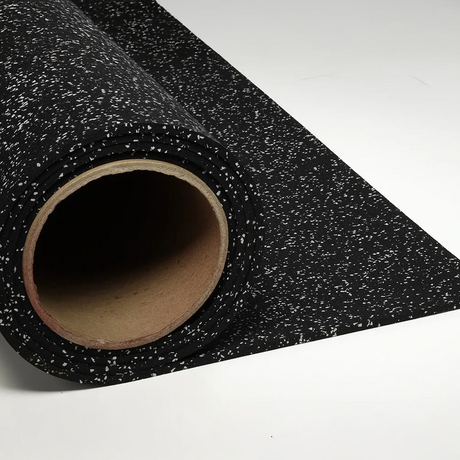
The Basic Fit Rubber Roll is the entry-tier composition rubber roll for lower-intensity zones — locker rooms, stretching areas, light cardio zones. Available in 6mm ($2.25/sq ft), 8mm ($2.65/sq ft), and 9mm ($3.15/sq ft) through Blue Sky. One important note: 6mm is appropriate for yoga and stretching areas but is not adequate for any zone with free weight use. If there's any chance a 45-pound plate gets dropped on that surface, specify 8mm minimum. The cost difference is minimal; the subfloor damage risk from under-specifying is not.
Don't spec one product across the entire facility. The operators who get flooring budgets right use tiered product selection by zone — heavy-duty where the activity demands it, entry-tier where it doesn't. If you're in the layout planning phase before finalizing your flooring spec, our guide on commercial weight room design for schools and universities walks through zone planning in detail and is worth reading before you order.

Ecore Athletic Performance Standards: What the Specs Actually Mean for Your Facility
Most flooring is sold on color options and warranty language. Ecore sells on published, testable performance data — and understanding why that matters is what separates a well-specified facility from one that's guessing.
ASTM F2772: The Standard That Actually Matters
ASTM F2772 is the key standard for indoor sports flooring performance testing. It covers five measurable performance properties: force reduction, energy restitution, vertical deformation, ball rebound, and surface friction. According to Ecore's resources page, the company publishes ASTM F2772 whitepapers and acoustical data sheets for its full Performance line.
What each metric means in plain language:
- Force Reduction: the percentage of impact force the floor absorbs before it reaches the athlete's joints and the subfloor. Higher force reduction = better joint protection and less structural transmission.
- Energy Restitution: how much energy the floor returns to the athlete. This is the NRG Factor in measurable terms — relevant for performance training zones.
- Vertical Deformation: how much the floor surface deflects under a concentrated load. Too little give and it's essentially concrete; too much and it's unstable underfoot.
- Surface Friction: the slip resistance coefficient. Critical for safety compliance and reducing fall risk in wet or high-intensity zones.
Having this data in writing during a procurement conversation changes the dynamic entirely. You're comparing testable numbers, not marketing language.
Acoustic Performance: What Rubber Does and Doesn't Do
According to Sport Pro Surfacing (May 2026), rubber flooring can reduce impact sound from dropped weights by 15–25 dB depending on thickness and density. That's meaningful noise reduction, but it's important to understand what rubber addresses and what it doesn't.
Acoustic noise in gyms comes from three distinct sources: impact (dropped weights hitting the floor), vibration (cardio machines transmitting through the structure), and reverberation (sound bouncing off hard surfaces like walls and ceilings). Rubber flooring addresses the first two effectively. It does nothing for reverberation, which requires acoustic wall panels or ceiling treatments. Specifying excellent rubber flooring and then wondering why the room still sounds loud is a common disconnect — plan your acoustic treatment holistically.
Multi-Story and Mixed-Use Buildings: Where This Gets Complicated
For upper-floor gyms in mixed-use or multi-family buildings, a rubber surface alone is often not sufficient to meet IIC (Impact Insulation Class) code requirements in many jurisdictions. The rubber surface reduces impact sound at the source, but structural vibration transmission through the concrete slab requires acoustic underlayment installed between the structural floor and the rubber surface to decouple the two systems.
Ecore's Approved Stacked Systems tech manuals address this directly — they're pre-engineered combinations of base layers and surface products tested together as a system. This gives architects and facility managers defensible, tested performance data for their specific building configuration, rather than relying on individual product specs that were tested in isolation. For a mixed-use building where your gym is above residential or office space, this documentation is what your architect needs to demonstrate code compliance.
Blue Sky can help facility buyers request and interpret Ecore's ASTM F2772 whitepapers, acoustical data sheets, and Approved Stacked Systems documentation before finalizing a spec. This is especially valuable for multi-story or mixed-use buildings where IIC compliance is on the table — having that documentation before you're mid-installation is significantly less painful than discovering a compliance gap afterward.

Ecore Athletic's Sustainability Credentials: What They Mean for Your Facility (Beyond the Green Story)
Sustainability in flooring is frequently talked about in terms of environmental stewardship, which is real. But for facility operators and corporate wellness buyers, the more immediately relevant angle is what these credentials translate to operationally — LEED credits, ESG reporting, reduced disposal liability, and recruiting appeal.
The Numbers Behind the Manufacturing Model
According to the SM Transparency Catalog (January 2026), Ecore products average 87% post-consumer recycled content, the company reclaims over 430 million pounds of rubber annually, and water recirculation systems conserve 17.5 million gallons of water per year. Ecore's Lancaster, PA facility has achieved a 99% landfill diversion rate, including 28% thermal processing with energy recovery.
These aren't aspirational targets — they're audited operating figures. For corporate buyers who need to populate ESG reports with vendor data, having a flooring supplier with third-party validated environmental metrics is a meaningful procurement advantage.
Certifications With Real Procurement Implications
Ecore's certification portfolio includes:
- FloorScore certification, which addresses indoor air quality — relevant for employee health in workplace gyms and essential for facilities with indoor air quality standards.
- Environmental Product Declarations (EPDs, ISO 14025 Type III) and Health Product Declarations (HPDs) that meet LEED v4 requirements — the documents your architect needs to claim Materials and Resources credits.
- MindClick Sustainability Assessment Program (MSAP) "Leader" status — Ecore's Vinyl + Composition Rubber, Calendered Rubber + Composition Rubber, and Composition Rubber lines all achieved Leader designation on a 200-point scale across nine environmental and social impact metrics.
TRUcircularity™: Risk Management, Not Just Green PR
The TRUcircularity™ Takeback Program is where Ecore's sustainability model becomes a direct operational benefit. At end of life, Ecore reclaims your flooring, repurposes the rubber into new products, and closes the manufacturing loop. For the facility, the benefit is concrete: you replace the floor without landfill disposal liability. The reclaimed rubber re-enters Ecore's closed manufacturing loop rather than your waste stream.
Rubber can be continually recycled without material degradation — unlike paper or plastic — which means Ecore's production scrap and reclaimed end-of-life material genuinely re-enters the system as usable raw material. This closed loop also contributes to consistent raw material quality across production runs, which has a quiet downstream benefit for product consistency.
For corporate wellness buyers pursuing LEED v4 or ESG reporting, Blue Sky can coordinate requests for Ecore's EPDs, HPDs, and the LEEDv4 Guide by product line. These documents are not always easy to locate independently, and having them ready during procurement simplifies the spec approval process considerably — especially if you're navigating a corporate facilities approval chain that requires documentation at each step.
For institutional buyers — schools, universities, municipal recreation centers — sustainability credentials can also support grant applications and alignment with public sector ESG commitments. Our guide on building a school weight room on a budget covers this angle for buyers working within institutional procurement constraints.

Ecore Athletic Customization, Branding, and Total Cost of Ownership
Customization as a Facility Differentiator
Ecore offers custom flooring colors, logo placement, and in-laid platforms — gyms and athletic facilities can integrate branding directly into the floor surface, according to data from Direct Fitness Solutions' Ecore brand documentation. For corporate wellness facilities, this is more than aesthetics. A floor with the company logo inlaid in an employee gym signals intentional investment in the space — a different message than a generic black rubber roll. In the context of recruiting and retention conversations, that signal matters.
Ecore turf is also engineered to prevent falls, absorb impact, and return energy to the body, making it a viable surface specification for functional training zones within commercial facilities. If you're building out a sled push corridor, a turf-based functional training zone, or an indoor agility area, the ECORE RageTurf Rally Interlocking Tile is a purpose-built option in that product category worth including in your specification comparison.
Total Cost of Ownership: The Actual Calculation
The right way to evaluate Ecore against generic rubber roll flooring is not price per square foot at purchase. It's total cost across the floor's service life. That calculation includes:
- Replacement frequency — a properly specified Ecore surface in the right zone lasts significantly longer than a commodity roll under the same conditions
- Maintenance requirements — composition rubber is sweep-and-mop with a neutral cleaner; no waxing, no special coatings, no quarterly treatment programs
- End-of-life disposal cost — eliminated for TRUcircularity™ enrollees
- Subfloor damage risk — inadequate shock absorption from under-specified flooring transmits impact to the structural floor; repairing or leveling a damaged subfloor is expensive
- Liability exposure from inadequate slip resistance — a published ASTM surface friction rating is defensible documentation; "it's rubber, it should be fine" is not
When evaluating Ecore against generic rubber roll flooring on a total cost of ownership basis, factor in: the TRUcircularity™ program eliminates end-of-life disposal cost, the ASTM-tested specs reduce liability exposure, and domestic manufacturing means more reliable lead times — all of which affect the real cost of the decision beyond price per square foot.
For reference on investment tiers: Basic Fit Rubber Roll runs $2.25–$3.15/sq ft depending on thickness (6mm–9mm) for lower-intensity zones. Bounce 2 Motivate 7mm Class 1 runs $8.45/sq ft for studio and high-traffic applications. Baller Rally 14mm Class 2 runs $9.95/sq ft for higher-impact studio zones. Performance-tier products (UltraTile, Performance Beast, Moxie Beast) are priced on configuration — contact Blue Sky for a zone-specific quote.
According to ProMarket Reports (April 2025), key drivers of gym flooring market growth include rising health consciousness, proliferation of boutique fitness studios, and growing awareness of injury prevention through appropriate flooring. Operators specifying better surfaces aren't just following a trend — they're responding to member expectations that are measurably rising.
For buyers considering outdoor or wet-area rubber surface applications — pool decks, outdoor turf zones, exterior functional training areas — our guide on rubber pool deck pavers covers non-slip surface specifications in those environments.

Ecore Athletic Product Lines at a Glance: Zone-by-Zone Selector
Use this table as a quick reference before your next procurement conversation. It's designed to give you the essential comparison points across Ecore's commercial product lines so you can walk into a spec meeting with a starting position.
| Product Line | Format | Thickness | Best Facility Zone | Use-Case Intensity | Starting Price (Blue Sky) |
|---|---|---|---|---|---|
| Performance UltraTile | Modular tile (24"x24") | 1" | Olympic/powerlifting platforms | Extreme weight drop | Contact for pricing |
| Performance Beast | Roll (itsTRU® VCR) | 10.5mm | Free weight rooms (all intensity levels) | Light conditioning to extreme Olympic lifting | Contact for pricing |
| Moxie Beast | Roll (dual-durometer) | Variable by configuration | Olympic/powerlifting zones | Extreme | Contact for pricing |
| Fit Collection | Roll (composition rubber) | Variable by product | General fitness floor, cardio, strength training | Moderate to heavy | Contact for pricing |
| Bounce 2 Motivate Class 1 | Laminate roll | 7mm | Studios, group fitness, high-traffic corridors | Moderate | $8.45/sq ft |
| Balanced Motivate Class 1 | Laminate roll | 7mm | Studios and moderate-traffic areas | Moderate | $9.95/sq ft |
| Baller Rally Class 2 | Laminate roll | 14mm | Higher-impact studio zones | Moderate-heavy | $9.95/sq ft |
| Basic Fit Rubber Roll | Roll (composition rubber) | 6mm / 8mm / 9mm | Locker rooms, stretching areas, light cardio | Light | $2.25–$3.15/sq ft |
| Blade Rubber Roll | Roll | 9mm | Multi-use utility zones | Moderate | $9.95/sq ft |
Note: Contact Blue Sky to confirm the right product for your specific subfloor and activity profile before ordering. Subfloor condition, building type, and use-case intensity all affect the correct specification — and getting that conversation right before you order saves significantly more than the time it takes.
Frequently Asked Questions About Ecore Athletic Flooring
What makes Ecore Athletic different from generic rubber gym flooring?
Several things, but the most operationally meaningful are: published ASTM F2772 performance data (force reduction, energy restitution, surface friction) so you're buying tested specs instead of marketing language; itsTRU® Technology with the NRG Factor (active energy return, not passive shock absorption); zone-specific product lines engineered for each area of the facility rather than a single product applied everywhere; LEED v4-compatible sustainability credentials; and domestic manufacturing from Lancaster, PA with consistent quality control. Generic commodity rubber typically offers none of these — it's rubber, it meets basic thickness specs, and you're trusting marketing copy for everything else.
Is Ecore Athletic flooring suitable for a commercial weight room?
Yes — specifically the Performance UltraTile (24"x24"x1" modular tile, engineered for moderate to extreme weight drop) and the Performance Beast (10.5mm VCR roll with eight base layer configurations spanning light conditioning to extreme Olympic lifting). Both are tested for the impact profiles generated in commercial free weight and Olympic lifting environments. For the most demanding powerlifting and Olympic zones, Moxie Beast's dual-durometer system is the appropriate specification. Do not apply Basic Fit Rubber Roll (6mm) in any zone with free weight use — 8mm is the minimum, and the Performance line is the right answer for true weight room applications.
Does Ecore flooring help with noise in a multi-story building?
Rubber flooring reduces dropped-weight impact noise by 15–25 dB depending on thickness and density. For upper-floor gyms, pair the rubber surface with acoustic underlayment between the structural floor and the Ecore surface — this decouples the two systems and is necessary to meet IIC code requirements in many jurisdictions. Specify using Ecore's Approved Stacked Systems documentation, which provides tested system performance data rather than combining products independently and hoping the result meets code. Rubber alone does not address reverberation — plan acoustic wall or ceiling treatment separately for that.
What is Ecore's TRUcircularity™ program and why does it matter?
TRUcircularity™ is Ecore's end-of-life takeback program. When your flooring reaches replacement age, Ecore reclaims it, repurposes the rubber into new products, and the material re-enters their closed manufacturing loop. For the facility, the operational benefit is concrete: no landfill disposal liability at replacement time. Rubber is continuously recyclable without material degradation, which means the reclaimed material genuinely contributes to new product. Ecore operates two UL Zero Waste to Landfill validated facilities — the program's credibility is backed by that infrastructure, not just a policy statement.
Can Ecore Athletic flooring help with LEED certification?
Yes. Ecore publishes Environmental Product Declarations (EPDs, ISO 14025 Type III) and Health Product Declarations (HPDs) that meet LEED v4 requirements. Request these documents during specification — they document Materials and Resources credits and Indoor Environmental Quality credits. Ecore also provides a LEEDv4 Guide organized by product line, which maps specific products to specific credit categories. If your facility is pursuing LEED certification, these documents are what your architect and LEED consultant need to claim those credits.
What Ecore products does Blue Sky carry?
Blue Sky Fitness Supply carries multiple Ecore Athletic product lines including the Basic Fit Rubber Roll (6mm, 8mm, and 9mm), Bounce 2 Motivate Class 1, Baller Motivate Laminate Roll 7mm Class 1, Balanced Motivate Laminate Roll 7mm Class 1, Baller Rally Laminate Roll 14mm Class 2, and Blade Rubber Roll. Performance-tier products including Performance Beast, Performance UltraTile, Moxie Beast, and Fit Collection are available — contact Blue Sky directly for configuration options and pricing on those lines.
How do I know which Ecore product is right for my facility zone?
Activity type and intensity level are the two primary variables. Use the zone-by-zone selector table above as your starting point. From there, your subfloor condition, building type (single-story vs. multi-story), and whether you're specifying for LEED compliance all affect the final call. The most reliable path is a specification conversation with Blue Sky before ordering — most ordering mistakes happen when someone dimensions the room, picks a product, and orders without accounting for subfloor variation, waste percentage, or zone-specific intensity mismatches.
Is Ecore Athletic flooring made in the USA?
Yes — manufactured in Lancaster, Pennsylvania. Production scrap is recycled back into the system in a closed manufacturing loop since rubber can be continually recycled without degradation. Domestic manufacturing means more consistent quality control across production runs, more reliable lead times than offshore suppliers, and a clearer accountability chain for specification and warranty support. For facilities that need to document domestic content for procurement or grant compliance purposes, Ecore's U.S. manufacturing is a direct compliance asset.

Extended FAQ: Specs, Costs, and Installation
1. What is Ecore Athletic itsTRU® Technology and how does it affect athletic performance?
itsTRU® Technology is Ecore's patented process that fusion-bonds vulcanized composition rubber (VCR) to surface materials through heat and pressure, creating what Ecore calls the NRG Factor. The result is a floor that actively returns energy to the athlete's body rather than passively absorbing impact and stopping there. For commercial operators, this means the floor contributes to athletic output in weight training and conditioning zones — a measurable, testable distinction from standard composition rubber flooring.
2. How thick should gym rubber flooring be for a free weight room?
A minimum of 8mm is required for any free weight zone, and the Performance line — starting at 10.5mm for the Performance Beast and 1" for the Performance UltraTile — is the appropriate specification for true weight room applications. The 6mm Basic Fit Rubber Roll is appropriate only for yoga, stretching, and no-drop zones. For Olympic lifting platforms or powerlifting environments with repeated extreme drops, Moxie Beast's dual-durometer system is the correct specification tier.
3. What ASTM standard should I reference when specifying gym rubber flooring?
ASTM F2772 is the primary standard for indoor sports flooring performance testing. It covers force reduction, energy restitution, vertical deformation, ball rebound, and surface friction — five measurable properties that allow you to compare flooring on tested data rather than marketing claims. Ecore publishes ASTM F2772 whitepapers and acoustical data sheets for its full Performance line, and having these documents in hand changes procurement conversations from qualitative to quantitative.
4. Are Ecore Athletic flooring products LEED v4 compatible?
Yes, Ecore products are LEED v4 compatible and the company publishes the documentation to prove it. Ecore provides Environmental Product Declarations (EPDs, ISO 14025 Type III) and Health Product Declarations (HPDs) for use in Materials and Resources and Indoor Environmental Quality credit categories, as well as a LEEDv4 Guide organized by product line. These documents are what your architect or LEED consultant needs to formally claim those credits during certification.
5. Can rubber gym flooring alone meet IIC code requirements in a multi-story building?
No — rubber flooring alone is generally not sufficient to meet IIC (Impact Insulation Class) code requirements in upper-floor gym applications. The rubber surface reduces impact sound at the source, but structural vibration transmission through the concrete slab requires acoustic underlayment installed between the structural floor and the rubber surface to decouple the two systems. Ecore's Approved Stacked Systems documentation provides pre-engineered, tested combinations that give architects defensible compliance data for specific building configurations.
6. How do I calculate how much Ecore flooring to order for my facility?
Start with precise square footage measurements for each zone, then add 2–3% for cut waste on tile installations and 5–7% for roll goods depending on room geometry. Irregular layouts, equipment footprints, and anchor points increase waste percentage — tile format minimizes this in complex zones. Budget waste separately by zone rather than applying a single facility-wide figure, since the free weight zone and the locker room have very different cut complexity.
7. What does Ecore Athletic flooring cost per square foot?
Entry-tier Basic Fit Rubber Roll starts at $2.25/sq ft for 6mm and runs to $3.15/sq ft for 9mm. Studio and high-traffic laminate options such as Bounce 2 Motivate 7mm Class 1 start at $8.45/sq ft, while Balanced Motivate 7mm Class 1 and Baller Rally 14mm Class 2 run $9.95/sq ft. Performance-tier products — Performance Beast, Performance UltraTile, and Moxie Beast — are configured to application and priced on request through Blue Sky. The correct comparison is always total cost of ownership over the floor's service life, not purchase price per square foot in isolation.
8. Is Ecore Athletic flooring appropriate for outdoor or wet-area applications?
Ecore engineers specific products for outdoor and wet-area environments, including turf surfaces for outdoor functional training zones and turf tiles designed for sled corridors and agility areas. For pool decks and consistently wet surfaces, the correct specification depends on slip resistance ratings and drainage requirements for that specific environment. Contact Blue Sky before ordering for any outdoor or wet-area application — subfloor prep and drainage conditions directly affect which product is appropriate and how it should be installed.
Flooring Is Infrastructure — Specify It That Way
Flooring doesn't generate the kind of excitement that new equipment does. Nobody posts about their new rubber rolls on social media. But it's one of the highest-leverage decisions in a commercial facility build-out or renovation because it affects member safety, equipment protection, acoustic performance, maintenance cost, and end-of-life disposal across a 10- to 15-year service window. Get it wrong once and you're replacing it every two years. Get it right and it's a solved problem.
Ecore's value proposition for commercial facilities is built on four pillars: engineered, zone-specific performance across the complete facility spectrum; published ASTM F2772 data so you're buying measurable specs instead of marketing claims; sustainability credentials that deliver real LEED v4 and ESG value with the documentation to prove it; and a domestic supply chain with closed-loop manufacturing that supports consistent product quality and reliable lead times. The global gym rubber flooring market is projected to reach $17.97 billion by 2032, according to ProMarket Reports — operators specifying quality surfaces are aligned with where the market is heading, not fighting it.
Blue Sky Fitness Supply is an authorized distributor of Ecore Athletic products. Whether you're specifying a single zone or flooring an entire multi-use facility, the team can help you match the right product line to the right application, pull ASTM documentation before you finalize your spec, and coordinate sustainability documentation for LEED or ESG reporting. If you're still in the layout stage, our complete guide to ECORE Athletic flooring solutions walks through zone planning and the full product architecture before you finalize your flooring spec — worth reading before you order.
When you're ready to specify, browse our Ecore Athletic flooring collection on Blue Sky Fitness Supply to see available product lines, current pricing, and configuration options — or reach out directly for a specification consultation.