

Table of Contents:
- What Is Yoga Strong and Why Is Everyone Searching for It in 2026?
- Yoga Strong vs. The Field: How the Best Alternatives Compare in 2026
- The Yoga Equipment Your Facility Actually Needs (And What to Skip)
- Yoga Flooring for Commercial Studios: The Foundation That Makes or Breaks Every Class
- The 2026 Business Case for Adding Yoga Programming to Your Commercial Facility
- Frequently Asked Questions
- Bottom Line: Yoga Strong Is a Format Worth Building Around — If Your Facility Is Ready for It
Yoga is a $107–$120 billion global industry in 2025, with over 300 million practitioners worldwide and 36+ million in the United States alone. Facility operators who dismissed yoga as a niche wellness offering five years ago are now watching it account for nearly 22% of their member programming participation. That is not a niche — that is a membership driver sitting inside your existing base, waiting to be activated.
Here is the part nobody is saying plainly: the term "Yoga Strong alternative 2026" is generating real search volume, and the results are Reddit threads, gear review sites ranking hot yoga mats, and consumer roundups built for solo practitioners. Not one of them is written for the gym owner, studio operator, or fitness director who needs to make a programming and infrastructure decision this quarter.
That is what this post is.
The real question is not whether Yoga Strong is worth it as a brand. The real question is whether your facility is positioned to deliver the resistance-meets-recovery format that is the single fastest-growing yoga category in 2026 — regardless of what you call it and regardless of which brand's accessories you stock. The hybrid yoga model, where traditional movement patterns meet functional strength work, is where the demand curve is pointing. The operators who understand that now will be the ones with full class rosters in 2027.
This post covers four things: what Yoga Strong actually is (and what it is not), how it compares against the realistic alternatives a commercial facility would consider, what equipment and flooring infrastructure you need to run any of these formats profitably, and the business case for making the investment now. According to India Yogashala's 2026 yoga statistics, the market is projected to reach $200+ billion by 2030 at a 9.4% CAGR. Health & Fitness Association data shows 21.8% of fitness facility members participated in yoga in 2024. The demand is not coming — it is already there.
What Is Yoga Strong and Why Is Everyone Searching for It in 2026?
Yoga Strong is a resistance-based yoga format — and a brand that sells accessories like foam rollers — that bridges traditional yoga movement patterns with functional strength training. It is not a yoga mat company. It is not a fitness app. It sits in the emerging hybrid space where someone who has been lifting weights for years decides they want to move better, recover smarter, and build the kind of body that still works well at sixty-five.
That positioning matters because it reflects a genuine cultural shift in how fitness consumers think about training. The mindset has moved from "how hard can I push today?" to "how well will I move at seventy?" Yoga's functional mobility and longevity benefits are no longer a soft selling point for people who don't want to lift — they are the primary value proposition for people who have been lifting for a decade and are starting to feel the wear. Yoga Strong sits directly at that intersection.
There is also a significant source of confusion worth addressing directly. Many searchers land on "Yoga Strong" when they are actually looking for Strong, the workout-logging app launched in 2014. According to a 2026 review from PRPath, Strong earned a 4.5/5 rating and remains one of the most widely used strength training trackers on the market — focused entirely on barbell and dumbbell logging, with no yoga component whatsoever. If you are a gym operator evaluating programming formats, these are entirely different categories. Make sure you know which one your members are asking about before you build a budget around it.
The people actually searching for "Yoga Strong alternative 2026" break into three groups. First, gym operators evaluating whether to add a branded hybrid yoga program to their timetable. Second, personal trainers building class schedules who want the hybrid format but are not committed to any single brand. Third, individual practitioners who have found the format resonates with them but want to understand whether there are comparable options at facilities near them. All three groups have legitimate needs — and all three are underserved by the consumer gear roundups currently ranking for this term.
The Yoga Strong Ridged Foam Roller ($22.95) is a useful product example for understanding the brand's market positioning. It is accessible, equipment-light, and designed to complement class-based programming rather than replace it. That price point tells you something about the brand's strategy: they are not competing in the premium recovery equipment tier. They are making hybrid yoga entry-level, which is smart given where the demand is coming from.
The broader trend data reinforces the format's staying power. PureGym's 2026 fitness report tracked a 2,414% spike in search interest for "walking yoga" — a format even more accessible and lower-intensity than Yoga Strong. When a format that gentle is growing that fast, it signals that mobility-first, low-impact movement is not a niche interest. It is the 2026 mainstream.
One more data point that operators need to internalize: 37% of yoga practitioners now use online platforms exclusively. That is the competitive backdrop any physical studio is operating against. Julz Arney, Senior Director of Fitness Technologies at Apple, framed it well: "Consistency isn't necessarily about doing more, it's about doing what fits." The formats that fit into people's real lives — approachable, repeatable, low-barrier to entry — are the ones that build retention. Yoga Strong and its alternatives are built on exactly that premise.
Based on Blue Sky's B2B customer base, facilities that add balance pads and commercial mats alongside their yoga programming see significantly higher accessory repurchase rates than facilities that offer yoga on bare rubber alone — practitioners quickly recognize quality and request it by name.
Yoga Strong vs. The Field: How the Best Alternatives Compare in 2026
This is a programming decision, not a gear purchase. Before you spend a dollar on mats or flooring, you need to know which format your facility is actually equipped to run — and which format your member base will actually show up for.
Glofox's Yoga Studio Playbook for 2026 identifies Vinyasa/Flow and Hatha as the volume drivers — the formats with the highest class fill rates and broadest demographic appeal. Restorative/Yin and strength-based hybrid formats like Yoga Strong are growing faster from a smaller base, which means they represent a differentiation opportunity for facilities willing to invest early. HIIT Yoga and Hot Yoga sit at a premium price point but carry higher infrastructure costs, particularly for HVAC in hot yoga settings.
According to Les Mills' 7 Key Trends Shaping Fitness in 2026, premium operators like Equinox and Third Space are actively expanding their Mind/Body timetables — adding enhanced yoga schedules, breathwork, and meditation — specifically because their retention data supports it. These are not facilities running yoga as a favor to a small member segment. They are running it because it works as a retention tool. For facility operators who are also tracking how wearable data and AI-assisted recovery tools are reshaping group programming decisions, the AI + Fitness Week 19 update on the mainstream moment covers how these technologies are beginning to influence class scheduling and member feedback loops in real commercial settings.
The demographic picture matters here. Gymdesk's 2026 fitness industry trends report identifies the 45-and-older cohort as one of the fastest-growing gym membership segments, with retention rates that consistently outperform younger members. Restorative/Yin, Hatha, and Yoga Strong-style hybrid formats serve this demographic better than HIIT Yoga or fast-paced Vinyasa. If your facility skews toward members in their forties and fifties — or you want to attract more of them — the format selection is clear.
Health & Fitness Association data confirms that 21.8% of fitness facility members participated in yoga in 2024, while 8.1% participated in Pilates. That gap suggests Pilates-adjacent mat strength classes have room to grow, and the crossover market between the two formats is meaningful — members who do one often migrate toward the other.
Yoga Format Comparison Table: Finding the Right Fit for Your Facility
The commercial sweet spot for studio mats sits in the 4mm–6mm range for comfort, easy-clean speed, and lifecycle value, per Mariana Tek's 2026 yoga studio flooring guidance — relevant regardless of which format you run. Dense rubber flooring at 3/8" to 5/8" thickness is the recommended substrate for multi-purpose yoga and fitness studios.
| Format | Member Demographic Fit | Equipment Required | Instructor Cert Barrier | Price Point for Members | Floor Space Needed |
|---|---|---|---|---|---|
| Yoga Strong (Resistance/Hybrid) | Fitness-focused adults 28–55; strength athletes seeking mobility | 4–6mm mats, resistance bands, foam rollers, balance pads | Moderate — RYT-200 + functional movement background preferred | $18–$28/class or premium membership tier | 35–50 sq ft per participant |
| Traditional Hatha / Vinyasa | Broadest demographic; ages 25–65+; beginner-friendly | 4–6mm mats, blocks, straps | Low to moderate — RYT-200 standard | $12–$22/class; drops in well to memberships | 30–40 sq ft per participant |
| HIIT Yoga / Hot Yoga | Ages 22–40; intensity-seekers; boutique gym crossover | 6mm+ non-slip mats, towels, hydration stations; heated HVAC system | Moderate to high — heated yoga specialty cert often required | $22–$40/class; premium drop-in model | 35–50 sq ft per participant; dedicated heated room |
| Restorative / Yin Yoga | Ages 40–70+; recovery-focused; highest-retention demographic | 4–6mm mats, bolsters, blocks, blankets, straps | Low — RYT-200 sufficient; specialty Yin training a differentiator | $15–$25/class; strong membership retention driver | 40–55 sq ft per participant (props need floor space) |
| Pilates-Adjacent Mat Strength | Ages 30–60; core-focused; strong female demographic | 4–6mm mats, resistance bands, light dumbbells, sliders | Moderate — mat Pilates cert or group fitness cert | $16–$28/class; pairs well with reformer upsell | 30–40 sq ft per participant |

The Yoga Equipment Your Facility Actually Needs (And What to Skip)
Format selection is strategy. Equipment selection is execution. Once you know which programming direction fits your facility, the gear list gets straightforward — and according to FLiiP's analysis of commercial gym programming, yoga requires minimal investment relative to its member engagement value. The catch is that the wrong gear creates real problems: mats that smell after a week of use, balance tools that compress incorrectly and create instability, flooring decisions that force you to cancel class when someone rolls an ankle.
Start with mats. The commercial sweet spot is 4mm–6mm thickness — firm enough for balance poses, cushioned enough for seated and supine work, and easy to wipe down between back-to-back classes. The Airex Calyana Advanced Yoga Mat (73" x 26" x 0.16" / approximately 4mm) at $99.99 hits this spec precisely. The 73" length accommodates taller practitioners — relevant when you are buying for a diverse member base rather than for yourself. Airex's closed-cell material resists moisture absorption, which matters enormously in a commercial setting where a mat that absorbs sweat becomes a hygiene problem by the third class of the day.
Balance and proprioception tools are where Yoga Strong and hybrid formats diverge from traditional yoga, and where the real equipment conversation begins. The Airex Balance Pad lineup gives facility operators genuine flexibility:
- Airex Balance Pad (16" x 20" x 2.5") — $94.99: the standard commercial workhorse, right-sized for standing balance work in most class formats
- Airex Balance Pad Elite (16" x 20" x 2.5") — $104.99: firmer density for advanced proprioception challenges, preferred in Yoga Strong-style programming
- Airex Balance Pad Cloud (16" x 20" x 2.5") — $104.99: softer surface, better suited to restorative formats and older-demographic classes
- Airex Balance Pad Mini (10" x 16" x 2.5") — $69.99: useful for hand-balance and wrist-loading exercises, pairs well with Pilates-adjacent programming
- Airex Balance Pad X-Large — $184.99: for full-body instability training stations and functional movement circuits
For facilities building out functional movement stations or physical therapy-adjacent programming, the Airex Balance Beam lineup adds a dimension that floor pads alone cannot replicate. The Balance Beam 64" ($189.99) creates a dedicated balance challenge that reads visually as a premium facility investment — members notice it, and it photographs well for social media. The Balance Beam Mini at 16" ($64.99) works as a versatile small-footprint addition that fits neatly into multi-use spaces.
Foam rollers round out the recovery side of any hybrid yoga kit. If you are also evaluating heat and vibration therapy tools to complement your recovery programming — a frequent pairing in hybrid yoga studios — it is worth reviewing how the Venom by Hyperice compares against heat therapy alternatives in 2026, particularly for post-class recovery stations. The full Yoga Strong collection at Blue Sky covers the accessories — foam rollers, mats, and recovery tools — that round out a commercially equipped hybrid studio.
For a 20-person Yoga Strong-style class, Blue Sky recommends a starter kit of 20 Airex Calyana mats, 10 Airex Balance Pads (a mix of standard and Elite), 20 foam rollers, and resistance bands per practitioner. Total outlay typically runs $3,500–$5,500 — comparable to the cost of two commercial treadmills, but with dramatically higher utilization per square foot and a member engagement profile that treadmills simply cannot replicate.
The yoga accessories market is projected to grow from $18.9 billion in 2025 to $28.4 billion by 2030, driven in part by sustainability as a purchasing driver. Clients in 2026 are gravitating toward eco-conscious yoga businesses — sustainable materials for mats and props, energy-efficient studio practices, and gear with genuine longevity. Airex's closed-cell construction means fewer replacements over time, which satisfies both the sustainability-minded member and the facility owner's replacement budget.

Yoga Flooring for Commercial Studios: The Foundation That Makes or Breaks Every Class
Flooring is the most overlooked purchase in yoga studio buildouts. It is also the one most likely to generate complaints, create injuries, or force class cancellations — and the one operators most regret getting wrong after the fact.
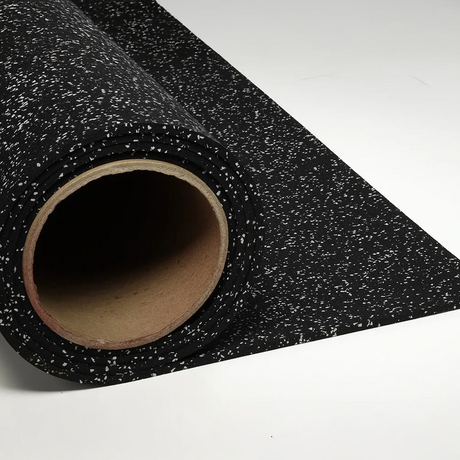
The spec for multi-purpose yoga and hybrid-format studios is clear. Mariana Tek's 2026 yoga studio flooring guidance identifies dense rubber at 3/8" to 5/8" thickness (roughly 10–15mm) as the commercial standard. Go thinner and the floor feels punishing for seated and supine floor work. Go softer — foam tiles, cushioned vinyl, thick gym turf — and you introduce unpredictable compression under balance poses. A warrior three on a surface that compresses laterally under the foot is not just uncomfortable. It is a fall waiting to happen.
Three distinct facility types have distinct flooring needs, and conflating them is where operators make expensive mistakes:
Dedicated yoga studio: Cork, wood-look rubber, or rubber-backed cork delivers the aesthetic warmth that sets a studio apart from a repurposed group fitness room, plus acoustic dampening that matters when the class above you is doing box jumps. These surfaces signal "this space was designed for this purpose," which is a meaningful differentiator in a competitive market.
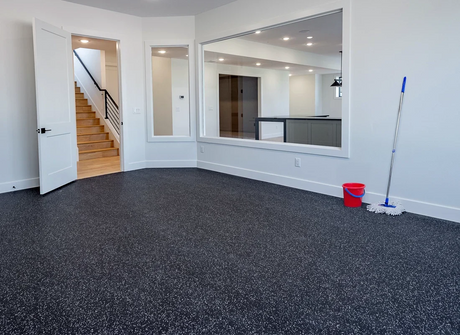
Multi-purpose hybrid class rooms — the spaces running Yoga Strong in the morning, HIIT at noon, and mobility work in the evening — need dense rubber that holds up under dynamic loading without seam gaps that catch toes during transitions. A 10–12mm dense rubber sheet or large-format tile is the right call here. The surface should be smooth or lightly textured, not the aggressive grip pattern designed for weight room drops.
Gym floor yoga zones, where a facility carves out a designated area within a larger rubber-floored space, require tiles that integrate visually and functionally with existing flooring. Color contrast between the yoga zone and the surrounding floor accomplishes two things: it creates a clear boundary for class organization, and it signals to non-class members that the space is in active use.
Blue Sky sees the most common yoga flooring mistake in commercial buildouts as operators choosing foam interlocking tiles — too soft for balance work — or thin gym rubber under 8mm, which is too hard for seated and supine floor work. The sweet spot for a hybrid yoga studio is 10–12mm dense rubber with a smooth or lightly textured top surface: grippy enough barefoot, cleanable with standard gym disinfectant, and acoustically respectful of neighboring spaces.
The corporate wellness angle adds another layer to the flooring conversation. According to Brocoders' 2026 update on yoga apps, over 70% of Fortune 500 companies incorporated yoga and meditation into employee wellness programs by 2025. Corporate facility buildouts — hotel fitness centers, university recreation centers, corporate campuses — carry different flooring priorities than boutique studios: aesthetics matter for client-facing spaces, acoustic dampening matters when offices are adjacent, and easy maintenance matters when custodial staff handles cleaning rather than fitness staff. The corporate wellness market is expected to reach $94.6 billion by 2026 — a distinct commercial channel that deserves its own spec conversation.
Rubber-backed cork and dense rubber are the preferred substrates for Yoga Strong and hybrid class studios for exactly these reasons: stability for balance poses, acoustic dampening that makes the space feel intentional, and durability under the dynamic movement loads that traditional yoga flooring was never designed to handle.

The 2026 Business Case for Adding Yoga Programming to Your Commercial Facility
The retention argument is where the business case for yoga becomes impossible to dismiss. Members with social connections at a gym cancel at dramatically lower rates than members who train in isolation. Yoga's group class format — structured, instructor-led, built around shared experience — is one of the most efficient ways to create those connections at scale. That is not a soft benefit. It is a cancellation prevention mechanism.
Zippia's yoga industry data puts the average American yoga practitioner's annual spend at $1,080 on classes, workshops, and equipment, with a lifetime spend estimated above $60,000. This is not a casual participant. This is a high-value, high-retention member who has made yoga a permanent part of their lifestyle — and who will choose a facility based on whether it supports that lifestyle with quality programming and equipment.
The digital competition concern is real, but the data is more nuanced than it first appears. Colorwhistle's 2026 yoga statistics show that 37% of practitioners use online platforms exclusively. That sounds threatening to physical studios. But members who use AI yoga apps outside the gym — apps offering real-time posture correction and hyper-personalized programs — often become the most engaged in-person attendees, showing up more educated and more consistent than members who do not practice outside the gym. For a closer look at how AI-driven fitness tools are reshaping member engagement and programming decisions in commercial facilities, the AI + Fitness Week 16 infrastructure update covers the technology layer that is beginning to run beneath the surface of modern group programming. The gym's advantage is community, guided instruction, tactile equipment feedback, and accountability. Compete on those dimensions.
Anna Bjurstam, Senior Strategic Advisor at Six Senses Hotels Resorts Spas, made the positioning case clearly at the HCM Summit in London: "Today's consumers demand integrated wellbeing solutions combining diagnostics, science, health and fitness to support longevity." That is not a description of a yoga class as a standalone product. It is a description of yoga as a component in a broader wellness ecosystem — which is exactly how operators should be framing it when presenting the investment to ownership or a board.
The corporate wellness channel deserves explicit attention. With 70%+ of Fortune 500 companies running yoga programs and the corporate wellness market approaching $94.6 billion, business-to-business facility operators — hotels, university recreation centers, corporate campuses — have a revenue channel here that most traditional commercial gyms are not actively pursuing. Facilities designed for multi-use programming (functional strength, yoga, recovery) are better positioned to capture corporate wellness contracts than single-purpose spaces.
Blue Sky's B2B observation: facilities adding even a basic yoga equipment package — mats, blocks, balance pads — see faster accessory repurchase cycles than facilities stocked only with heavy iron. Yoga practitioners replace mats and recovery tools on a 12–18 month cycle, compared to the 5–10 year replacement cycle of barbells. That recurring revenue stream is modest per transaction but highly predictable, and it compounds over time as your yoga member base grows.
The long-term market trajectory makes the investment case straightforward. According to Wellyx's yoga industry statistics, the global market is projected to surpass $273 billion by 2034, growing at 9% CAGR from 2025 forward. Operators who build the infrastructure now — quality flooring, commercial-grade mats, balance equipment, instructor development — are positioning on the front end of a decade-long growth curve. Operators who wait will be building into an already-crowded market at higher costs.

Frequently Asked Questions
1. What is Yoga Strong and how is it different from traditional yoga?
Yoga Strong is a resistance-based hybrid yoga format that blends traditional yoga movement patterns with functional strength training. Unlike traditional Hatha or Vinyasa, which prioritize flow and breath, Yoga Strong incorporates resistance tools such as foam rollers, bands, and balance pads to build strength alongside mobility. The format attracts fitness-focused adults who want longevity-oriented movement rather than pure intensity, and it is the fastest-growing yoga sub-category in commercial programming in 2026. The Yoga Strong brand also sells accessories designed to complement the format.
2. Is Yoga Strong the same as the Strong workout app?
No, Yoga Strong and the Strong app are entirely separate products. Yoga Strong is a hybrid yoga programming format and accessory brand; the Strong app is a barbell and dumbbell workout tracker launched in 2014 with no yoga component whatsoever. Gym operators evaluating programming investments should confirm which one their members are referencing before building a budget or purchasing a subscription, as the two categories have no functional overlap.
3. What are the best Yoga Strong alternatives for a commercial facility in 2026?
The strongest commercial alternatives are Vinyasa/Flow (highest class volume and broadest demographic appeal), Restorative/Yin (top format for the 45-and-older retention demographic), Pilates-adjacent mat strength (meaningful crossover market with yoga), and HIIT Yoga or Hot Yoga (premium price point, higher infrastructure cost). The right choice depends on your member demographic, available floor space, instructor talent pool, and how much capital you can commit to HVAC or equipment upgrades. Restorative and hybrid formats offer the clearest differentiation opportunity for facilities entering the yoga space now.
4. What equipment does a commercial facility need to run a Yoga Strong-style class?
At minimum, a commercial Yoga Strong setup requires 4–6mm closed-cell yoga mats, foam rollers, and resistance bands per practitioner. A full hybrid studio should also include Airex Balance Pads in standard and Elite densities ($94.99–$104.99 each) for proprioception work, and optionally Balance Beams for advanced balance training stations. Budget approximately $1,500–$3,000 to equip a 15–20 person class at the starter level, or $3,500–$5,500 for a complete hybrid kit including commercial mats, balance pads, foam rollers, and bands.
5. What is the best flooring for a Yoga Strong or hybrid yoga studio?
Dense rubber at 3/8" to 5/8" thickness (10–15mm) is the commercial standard for hybrid yoga and Yoga Strong-style studios. This thickness is firm enough to prevent ankle instability during balance poses, durable under the dynamic loading of hybrid formats, and acoustically dampening compared to harder substrates. Avoid foam interlocking tiles, which compress unpredictably underfoot and create instability during single-leg balance work. For dedicated yoga studio spaces, rubber-backed cork adds aesthetic warmth alongside the same functional benefits.
6. How can a physical gym compete with online yoga platforms in 2026?
Physical facilities compete most effectively on community, guided instruction, and equipment quality — not on content volume. Research shows that members who use AI yoga apps at home often become the most consistent in-person attendees, arriving more educated and more motivated than members who do not supplement with digital tools. The gym's irreplaceable advantages are real-time instructor feedback, tactile equipment, social accountability, and the class experience itself. Focus investment on those dimensions rather than trying to match digital platforms on content breadth.
7. Is adding yoga programming worth the investment for a commercial gym?
Yes, by nearly every commercial metric available. Yoga group classes build social bonds that measurably reduce cancellations, serve the high-retention 45-and-older demographic, and attract members who spend an average of $1,080 per year on yoga-related fitness. Equipment costs are far lower than cardio or strength equipment, flooring requirements are manageable, and yoga accessories generate 12–18 month repurchase cycles that produce reliable recurring revenue. The format also opens a pathway to corporate wellness contracts as more employers build on-site or subsidized fitness programs.
8. Which yoga format has the highest retention impact for commercial facilities?
Restorative and Yin yoga formats consistently drive the strongest retention outcomes, particularly among the 45-and-older membership segment, which already outperforms younger members on retention rates across the industry. Yoga Strong-style hybrid formats perform well with the 28–55 fitness-focused demographic, delivering both a programming differentiator and social class bonds that reduce churn. Vinyasa and Hatha deliver the highest raw class volume and broadest demographic reach but are less likely to create the deep practitioner loyalty that cements long-term membership retention.
Bottom Line: Yoga Strong Is a Format Worth Building Around — If Your Facility Is Ready for It
Three things are true coming out of this post. First, Yoga Strong is a legitimate and fast-growing hybrid format — not just a brand name, not an app — and its alternatives all have viable commercial applications depending on your facility type, member demographic, and floor space. The format comparison matters before the gear conversation begins.
Second, the equipment investment is low relative to the retention return. A $3,500–$5,500 class kit that drives group class attendance, creates social bonds among members, and generates 12–18 month repurchase cycles on mats and recovery tools is not a cost center. It is a retention tool with a measurable return.
Third — and this is where operators most commonly underinvest and regret it — flooring and infrastructure decisions made at buildout are difficult and expensive to undo. Getting the substrate right from the start (dense rubber, 10–12mm, smooth to lightly textured) is cheaper than replacing foam tiles that fail under balance work eighteen months into operation.
The market context is not ambiguous. The global yoga industry sits at $107–$120 billion in 2025, growing at 9.4% CAGR toward $200+ billion by 2030. Twenty-one point eight percent of your fitness facility members already participate in yoga. That demand is not future-looking — it is inside your current membership base, right now, looking for programming worth showing up for.
Blue Sky Fitness Supply stocks the commercial yoga equipment and rubber flooring that Yoga Strong-style facilities are built on — from Airex mats and balance pads to commercial rubber flooring systems. Browse our commercial yoga and balance equipment collection, or reach out directly to our team to spec out a hybrid studio package for your specific facility. If you are also evaluating functional movement infrastructure, the Blue Sky Slant Board Training Guide covers related flooring and equipment considerations for multi-use training spaces.