

Table of Contents:
- The Complete Guide to Hypervolt Attachments: What Each Head Is Designed to Do
- Hypervolt Attachment Compatibility: What Works With Which Device Generation
- Hypervolt Attachment Quick-Reference: Use Cases at a Glance
- How to Match Hypervolt Attachments to Speed Settings for Real Results
- Safety, Sanitation, and Staff Training: What Commercial Buyers Need to Get Right
- Frequently Asked Questions
- Right Attachment, Right Outcome
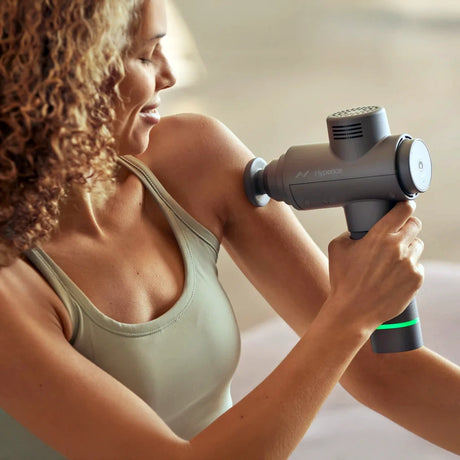
Percussion therapy has become a standard fixture in commercial gyms, physical therapy clinics, and corporate wellness rooms. Hypervolt attachments are part of that conversation every time a facility manager specs out a recovery station or a clinic director onboards a new modality. The problem is that most people — staff included — grab whatever head is already clipped to the gun and press it into whatever muscle is in front of them. That's exactly backwards.
Here's where it gets interesting: the attachment you select matters as much as the speed setting. Using the wrong head on the wrong tissue at the wrong intensity doesn't just underdeliver — in clinical environments, it can cause real harm. A 2023 systematic review published on PubMed found that a single session of percussive therapy produced acute gains in muscle strength and flexibility, while multiple sessions reduced musculoskeletal pain. But those outcomes don't happen automatically. They depend on the right protocol — and protocol starts with the attachment.
The contrarian reality most facilities miss? The five-head system on a Hypervolt isn't complicated. Each attachment follows a clear design logic: surface area, firmness, and contact geometry map directly to tissue type and treatment goal. Once you understand that logic, selection becomes almost automatic.
This post is written for facility managers, clinic directors, and corporate wellness buyers who need to train staff, justify equipment choices, and get consistent results across multiple users. Per Hyperice's official documentation, the original Hypervolt ships with five interchangeable head attachments — fork, bullet, flat, cushion, and round — plus three speed settings. We stock Hypervolt devices and attachment sets at Blue Sky Fitness Supply and field enough B2B questions about head selection and compatibility to know exactly where the confusion lives. This breakdown covers every attachment, who it's for, how it maps to speed settings, what changes across device generations, and what commercial operators need to get right on safety and sanitation.
The Complete Guide to Hypervolt Attachments: What Each Head Is Designed to Do
Five heads. Five distinct tissue profiles. Here's what each one does — and more importantly, when to reach for it.
Cushion
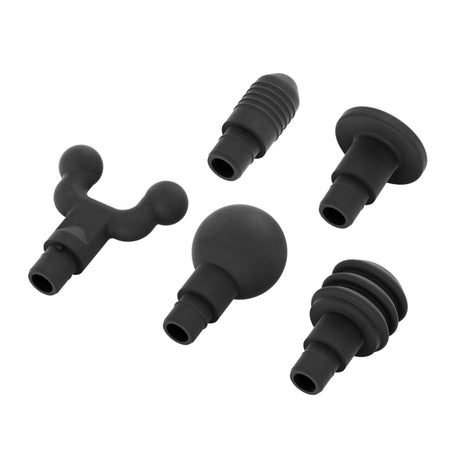
The Cushion is the softest attachment in the set, with the largest surface area of any Hypervolt head. According to Hyperice's EU support documentation, it provides more "give" on tender spots and sensitive areas like the neck — making it the recommended starting point for beginners. In clinical settings, it's the natural choice for intake sessions with patients who have never experienced percussive therapy. The Cushion absorbs impact before it reaches tissue, which is why it's also appropriate for post-acute recovery where muscle soreness makes any direct pressure uncomfortable.
Round (Foam Ball)
One step firmer than the Cushion, the Round attachment — sometimes called the Foam Ball — maintains roughly the same surface area but delivers slightly more density into the target tissue. Hyperice's documentation identifies it as well-suited for large muscle groups: quads, lats, pecs. In a commercial gym context, this is the workhorse attachment. Post-class recovery stations, cool-down areas, and member self-service recovery corners will see this head used most often. It provides enough feedback to feel effective without the pinpoint intensity that requires technique to manage safely.
Flat
Medium firmness, medium surface area. The Flat head is a general-purpose attachment for dense muscle tissue and full-body sweeps. Experienced users default to it because it handles most situations adequately without requiring much deliberate thought about tissue sensitivity. It's also the attachment most often left on the device between sessions in busy facilities — which, as we'll discuss, is both understandable and a symptom of under-training.
Fork
The Fork is the most specialized attachment in the standard set. Its two-prong design is built for paraspinal muscles, upper traps, forearms, and ankle/calves — specifically designed to avoid direct contact with the spine or the Achilles tendon while working the surrounding tissue. What makes it unique mechanically: it's the only Hypervolt attachment with an alignment tab that prevents it from rotating during use. That tab requires deliberate orientation when inserting the head. In commercial and clinical settings, staff who haven't been trained on the Fork's tab-and-groove alignment system will often insert it incorrectly, which defeats the design entirely.
Bullet
The Bullet has the smallest surface area of any head in the set. Per Hyperice's official support documentation, it's designed for smaller or harder-to-reach muscle groups and trigger points. The concentrated contact area means it delivers more localized pressure per unit of force — which is useful for targeted trigger point release and less useful (and potentially harmful) if applied to bony prominences. Speed matters more with the Bullet than any other head: too fast and you're sensitizing tissue rather than releasing it.
For commercial and clinical buyers, the procurement lesson here is direct. Across B2B orders we fulfill at Blue Sky, the most common gap we see is facilities purchasing a Hypervolt Attachment Set without a plan for which attachment gets used in which context. A device stocked with only the Flat head left on by default — because nobody trained staff on the others — is a $229 tool delivering maybe 40% of its value. Attachment training is part of the ROI equation. The hardware is only as effective as the protocol built around it.
Hypervolt Attachment Compatibility: What Works With Which Device Generation
This is where procurement errors happen most often in multi-unit B2B environments. Not every Hypervolt attachment fits every Hypervolt device. Ordering the wrong replacement heads for the wrong generation wastes money and creates operational friction on the floor.
There are three distinct device tiers to understand.
Hypervolt 1 and Hypervolt 2 Lines
The original five-head attachment set — Cushion, Round, Flat, Fork, and Bullet — is compatible with both the Hypervolt 1 and Hypervolt 2 lines. The standard Attachment Set ($25.00) that Blue Sky stocks as a standalone SKU fits these devices. According to Hyperice's official product documentation, however, this five-head set is not compatible with the Hypervolt 3 line. That distinction matters enormously when a facility is running a mixed fleet of older and newer devices.
Hypervolt 3 Pro
The Hypervolt 3 Pro ships with five attachments of its own, including the Heated Head Attachment — a meaningful spec upgrade that combines thermotherapy with percussion in a single modality. The device operates at six speeds ranging from 1,500 to 2,500 RPM and integrates pressure sensor technology that lets users dial in treatment intensity with more precision than the three-speed original. The Heated Head Attachment is also available as a standalone purchase at $59.00, which positions it as an upgrade option for clinics already running the 3 Pro that want to add a heat protocol without purchasing a second device.
As Future Market Insights notes in their 2025 market analysis, the development of modular specialty heads for joint-specific and clinical applications represents a growing trend in the percussion device category — the Heated Head Attachment is a practical example of that direction already in market. If you're evaluating whether the full Hypervolt lineup makes sense for your facility, our in-depth Hyperice massage gun features and benefits review covers device-level performance differences in detail.
Hypervolt Go 3
The compact Go 3 is a different animal. It ships with only two attachments: the Flat and Wedge heads. Five speeds, 1,500–2,500 RPM range, up to four hours of battery life via USB-C charging. It's a capable travel and satellite unit, but facilities should not assume it provides the same attachment versatility as the full-size lineup. For corporate wellness rooms where the device is accessible to employees without staff supervision, the simplified two-head setup is actually a feature — fewer decisions, lower misuse risk.
When facilities purchase multiple Hypervolt units across different generations, attachment compatibility errors are one of the most common and avoidable procurement mistakes. Always confirm device model numbers — Hypervolt 1/2 versus Hypervolt 3 — before ordering replacement attachment sets. At Blue Sky, we flag this at the order stage for all multi-unit B2B accounts. A quick model number check before the purchase order is processed has saved facilities from receiving $200+ in unusable replacement heads.
The practical summary: if your fleet is mixed-generation, treat attachment procurement as device-specific, not fleet-wide. The $25 standard attachment set and the $59 Heated Head Attachment are both available through Blue Sky individually — but compatibility verification comes first.

Hypervolt Attachment Quick-Reference: Use Cases at a Glance
Use the table below as a training reference for gym staff, clinic aides, or corporate wellness room attendants. Print it, laminate it, and post it near the device. It's worth five minutes of setup to prevent months of improper use.
| Attachment | Firmness / Surface Area | Primary Target Areas | Best Use Case | Experience Level |
|---|---|---|---|---|
| Cushion | Softest / Largest | Neck, tender spots, sensitive tissue | First-time users, post-acute clinical sessions | Beginner / Clinical intake |
| Round (Foam Ball) | Medium / Large | Quads, lats, pecs, large muscle groups | Post-workout recovery, general maintenance | All levels |
| Flat | Medium-firm / Medium | Dense muscle tissue, full-body sweeps | Daily general use, experienced users | Intermediate / Advanced |
| Fork | Medium / Narrow (two-prong) | Paraspinals, upper traps, forearms, calves | Spinal and bilateral muscle work | Intermediate / Clinical (trained staff) |
| Bullet | Firmest / Smallest | Trigger points, small or deep muscles | Targeted trigger point release | Intermediate / Clinical |
| Heated Head (3 Pro only) | Medium / Medium | Joints, soft tissue | Combined heat + percussion therapy | Clinical / Specialist recovery |
The standard Attachment Set ($25.00) and the Heated Head Attachment ($59.00) are both available individually through Blue Sky Fitness Supply — useful for facilities that need replacement heads or want to equip multiple staff members with dedicated attachment kits without purchasing additional full devices.

How to Match Hypervolt Attachments to Speed Settings for Real Results
Attachment selection is half the equation. Speed is the other half. Getting one right while ignoring the other leaves meaningful clinical and performance outcomes on the table.
The original Hypervolt operates at three speed levels: Level 1 at 30 Hz / 2,400 PPM, Level 2 at 40 Hz / 2,800 PPM, and Level 3 at 53 Hz / 3,200 PPM, driven by a 60-watt brushless motor. Those aren't arbitrary numbers — each frequency range produces a different neuromuscular response, and the attachment you pair with each level determines how that response lands in tissue.
Recovery Protocol
For post-workout recovery, Sports Injury Physio's evidence-based guidelines recommend low frequencies — 2,400 PPM or below — for two to five minutes per muscle group. Pair Level 1 with the Cushion or Round head. The Round head's medium density on large muscle groups like quads and lats, combined with a low frequency, promotes circulation and lactic acid clearance without overloading sensitized tissue. UCLA Health notes that percussion forces muscle fibers to release lactic acid, which directly supports the case for deploying Hypervolt access in post-class cool-down zones of commercial facilities.
Flexibility and Mobility Protocol
Short-duration treatments — under two minutes — at higher frequencies support acute flexibility gains. Use Level 2 or Level 3 with the Flat or Round head on large muscle groups. The research is worth citing directly: a 2023 PubMed systematic review found that a single percussive therapy session produced acute gains in muscle strength and flexibility, while multiple sessions reduced musculoskeletal pain. That distinction matters for protocol design. Short-term performance goals (pre-class mobility) call for a different attachment-speed combination than long-term recovery goals (DOMS reduction over 48–72 hours).
Pre-Workout Activation
Keep pre-workout sessions to 15–30 seconds per muscle group. The goal is activation, not fatigue. The Round or Flat head at moderate speed (Level 2) covers most major muscle groups efficiently. Go longer than 30 seconds per site pre-workout and you risk reducing neuromuscular drive rather than enhancing it — the opposite of the intended effect.
Trigger Point Work
The Bullet head at Level 1 — the lowest speed setting — is the right combination for trigger point release. Hold for 30–60 seconds over the target area. Do not press onto bony prominences. Do not use higher speed settings on trigger point work; you're trying to release a sensitized area, not drive more stimulation into it. The Mayo Clinic Store's overview of percussive therapy notes that percussion stimulates both mechanoreceptors and proprioceptors — which is why concentrated, low-speed contact on a trigger point can reduce pain perception without aggravating it.
Fork Head Protocol
Lower to moderate speed along the paraspinals and upper traps. Orient the alignment tab correctly before applying. Stay completely off the Achilles tendon — the Fork's two-prong design means it spans that area, but contact with the tendon itself is contraindicated. For forearm work, Level 1 or Level 2 provides sufficient depth without the risk of bruising that comes from high-frequency contact on a smaller muscle mass.
One clinical note worth flagging for physical therapy and rehab settings: Hyperice's QuietGlide technology means the device can be used in a treatment room without disrupting adjacent providers or patients. Garage Gym Reviews' detailed Hypervolt analysis confirms that users can hold a conversation at normal volume while the device runs — a legitimate operational advantage in shared clinical spaces where noise bleeds between rooms. Facilities pairing percussive therapy with contrast recovery protocols may also find it useful to review everything you need to know about ice baths, since the two modalities are increasingly used together in structured post-workout recovery programs.

Safety, Sanitation, and Staff Training: What Commercial Buyers Need to Get Right
This section is written directly for the people who bear liability for how these devices are used on other people. That means physical therapy clinic directors, gym operators, and corporate wellness managers — not solo users managing their own recovery.
Attachment Change Protocol
Hyperice's official guidance is unambiguous: attachments should only be changed after the device is switched off and the head has stopped moving completely. In high-traffic environments — a busy gym recovery station, a PT clinic during a full patient day — this step gets skipped constantly. A rotating head making contact with a finger during a swap is not a theoretical risk. It's a real one. Post this rule where the device lives, not just in the onboarding manual.
No Lotions, No Oils
The Hypervolt and its attachments must never be used with lotions, oils, or any lubrication media. Per Hyperice's user documentation, this can clog and permanently damage the device. This error shows up most often in spa settings, recovery centers that also offer soft tissue massage, and corporate wellness rooms where staff improvise. The message for facility buyers is simple: add this to your posted signage, not just your verbal training script.
Contraindications Every Operator Must Post
Conditions where Hypervolt use can cause serious harm include: pregnancy, diabetes, pacemakers, recent surgery, epilepsy, migraines, herniated discs, DVT and blood clotting disorders, osteoporosis, and active inflammation. Per Hyperice's user guide (referenced in EdTechBooks' compiled documentation), these are not precautions to bury in fine print — they're conditions that require device access to be restricted entirely or managed through individual clinical assessment.
Gary Calabrese, DPT, of Cleveland Clinic has noted that patients with diabetes, osteoporosis, blood clotting disorders, or neurological conditions require individualized evaluation before percussive therapy is applied. For physical therapy clinics reading this: that means the Hypervolt is not a device you hand to every patient in the waiting room as a self-treatment option. It requires clinical gatekeeping.
The Neck: Non-Negotiable Exclusion Zone
The front of the neck is off-limits. Physical therapists — including Bob Schrupp and Brad Heineck, whose reach spans millions of followers in the rehab community — cite this as the single most dangerous misuse of percussion devices. The vital veins and arteries in the anterior neck create a real risk of pain, injury, and stroke-like symptoms from direct percussion. This belongs in the first line of any staff training script, not buried in a warning label.
Sanitation Between Users
Attachment heads should be wiped down with appropriate disinfectant wipes between users in any multi-person setting. The detachable design supports a clean/dirty workflow: remove, wipe, allow to dry, reattach. Designate a small tray or staging area near the device so staff can execute this without improvising. For clinical settings where infection control is regulated, confirm that your chosen disinfectant is compatible with the attachment material before deploying at scale.
Documentation and Onboarding Support
In high-traffic commercial environments — gyms, clinics, corporate wellness rooms — the attachment change safety step (power off, wait for full stop) is routinely skipped. We recommend facilities create a laminated quick-reference card posted beside the device covering: attachment use guide, contraindications, and the power-off-before-swap rule. Blue Sky can provide product documentation for B2B buyers building staff onboarding materials.
TSA Note for Traveling Clinicians
The Hypervolt is TSA-friendly for carry-on bags. It cannot, however, be transported in checked baggage — Hyperice's official guidance specifies this restriction applies due to the lithium-ion battery. For sports medicine staff, traveling athletic trainers, or clinicians who move between clinic locations, this is a practical planning point worth flagging upfront.

Frequently Asked Questions
1. What attachments come with the Hypervolt?
The original Hypervolt and Hypervolt 2 line include five heads: Cushion, Round (Foam Ball), Flat, Fork, and Bullet. The Hypervolt 3 Pro ships with five heads as well, but the set includes a Heated Head Attachment rather than the same five from the original line. The Hypervolt Go 3 includes only two attachments: Flat and Wedge. Per Hyperice's official product specifications, device generation determines which attachment set ships with the unit — and they are not cross-compatible.
2. Are Hypervolt attachments interchangeable between models?
No, Hypervolt attachments are not fully interchangeable between all device generations. The standard five-head attachment set is compatible with Hypervolt 1 and Hypervolt 2 lines, but not with the Hypervolt 3 line. Hyperice's product documentation is clear on this, and it's a common source of procurement errors for facilities running mixed-generation fleets. Always confirm your device generation before ordering replacement heads — Hypervolt 1/2 versus Hypervolt 3 are not the same attachment ecosystem.
3. Which Hypervolt attachment is best for beginners?
The Cushion head is the best Hypervolt attachment for beginners. It has the softest material and the largest surface area, providing the most "give" on tender or sensitive areas. It's the recommended starting point for new users and for clinical patients being introduced to percussive therapy for the first time. According to Hyperice's EU support documentation, it's particularly appropriate for sensitive areas like the neck — though even with the Cushion, the front of the neck remains a contraindicated zone.
4. Can I use the Bullet attachment on any muscle?
The Bullet attachment is not designed for general use across all tissue types — it is intended for small muscle groups and trigger points only. It should not be pressed onto bony prominences, and it should be used at lower speed settings with a recommended application time of 30–60 seconds per site. Used correctly at low speed, it is highly effective for trigger point release. Used at high speed on the wrong tissue type, it can cause pain sensitization rather than relief.
5. How do I safely change Hypervolt attachments?
To safely change Hypervolt attachments, power the device off completely and wait for the head to stop moving before swapping. This is Hyperice's official guidance and a critical safety step. It's a step that gets skipped constantly in busy commercial environments — which is exactly why it needs to be posted visibly next to the device, not just mentioned once during staff onboarding.
6. Can I use lotion or oil with Hypervolt attachments?
No, Hypervolt devices must never be used with lotions, oils, or lubricants of any kind. Per Hyperice's user guide documentation, doing so can permanently damage the device by clogging its internal components. This mistake appears most often in spa and recovery center settings where soft tissue work and percussion are offered in the same space. Keep the two modalities separate and post a clear no-lotion reminder wherever the device is stored.
7. What is the Hypervolt Heated Head Attachment and who is it for?
The Hypervolt Heated Head Attachment ($59.00) is an accessory designed exclusively for the Hypervolt 3 Pro that combines thermotherapy with percussion in a single application. It is best suited for clinical or recovery-focused environments adding heat protocols for joint or soft tissue treatment. It is also available as a standalone purchase, making it a viable upgrade for clinics already running the 3 Pro that want to expand their modality offering without acquiring new equipment.
8. How long should I use each Hypervolt attachment per muscle group?
Recommended usage time varies by protocol and attachment: for recovery, use two to five minutes per muscle group at low frequencies (2,400 PPM or below); for flexibility gains, keep sessions under two minutes at higher frequencies; for pre-workout activation, limit contact to 15–30 seconds per muscle group. For trigger point work with the Bullet head, apply for 30–60 seconds per site at the lowest speed setting. These protocols are supported by the evidence reviewed in the 2023 PubMed systematic review and are consistent with Sports Injury Physio's clinical usage guidelines.
Right Attachment, Right Outcome
The five standard Hypervolt attachments aren't interchangeable. Each one is engineered for a specific tissue type, treatment goal, and user population. Using the right head in the right context — at the right speed — is what separates a device that collects dust from one that delivers consistent, measurable results across an entire member base or patient roster.
For physical therapy and chiropractic clinics: the Cushion and Fork heads are your clinical workhorses. The Heated Head Attachment is a meaningful upgrade for practices adding thermotherapy protocols. Staff training on contraindications and the attachment change safety step is not optional — it's the baseline for responsible deployment. B2B sales to healthcare providers and orthopedic clinics are among the primary growth drivers of the percussion device market projected through 2035 according to Future Market Insights, which signals where the clinical standard is heading.
For commercial gyms and rec centers: the Round and Flat heads handle the majority of post-workout recovery use. QuietGlide technology keeps the recovery area functional without noise complaints from adjacent spaces. Stocking the $25 attachment set as a routine replacement supply item prevents device downtime when heads wear or go missing in a high-traffic environment.
For corporate wellness buyers: the Hypervolt's compact footprint, quiet operation, and straightforward attachment system make it deployable in office wellness rooms with minimal staff supervision — provided a clear one-page guide is posted and the contraindication list is visible. The simpler two-head configuration of the Go 3 is worth considering for unsupervised corporate settings precisely because it reduces decision complexity for untrained users.
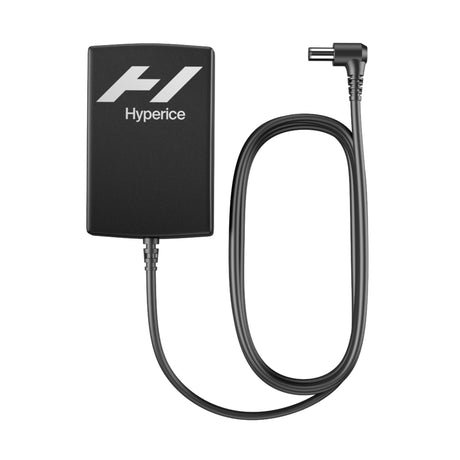
Blue Sky Fitness Supply stocks the Hypervolt 2, Hypervolt 2 Pro, Hypervolt Go 2, individual Heated Head Attachments, standard Attachment Sets, and Charging Cables. Whether you're outfitting a single recovery station or a multi-location network, reach out to our B2B team to discuss volume pricing, device generation compatibility, and configuration guidance. Our Hyperice and Hypervolt collection is the right starting point — and if you're building a full recovery ecosystem beyond percussion, our cold plunge and recovery gear offerings are worth exploring alongside it.